The shift from R-134a to the newer R-1234yf refrigerant in 2026 vehicles demands distinct service procedures and equipment. The refrigerants are not interchangeable; mixing them causes cross-contamination, leading to costly damage, internal acid buildup, and significant vehicle downtime. Fleet owners must prioritize accurate identification and precise servicing as preventative maintenance to ensure vehicle reliability in Chandler’s heat.
Why the R-1234yf Shift Matters for Fleets in 2026
The service margin for error in newer R-1234yf systems is significantly smaller. Years ago, many vehicles in the field still used R-134a, and most shops were set up around it. In 2026, more late-model trucks and fleet vehicles will be built around R-1234yf, which uses different service equipment, different handling procedures, and tighter contamination control.
For a fleet, that matters because refrigerant mistakes can lead to:
- Vehicle downtime
- A/C performance issues
- Seal and component damage
- Cross-contaminated recovery machines
- Repeat repairs that should have been avoided
In Arizona, where climate systems are not optional for operators, dispatch teams, and service crews, that’s a real operational issue—not just a comfort complaint.
The Technical Comparison R-1234yf Versus R-134a
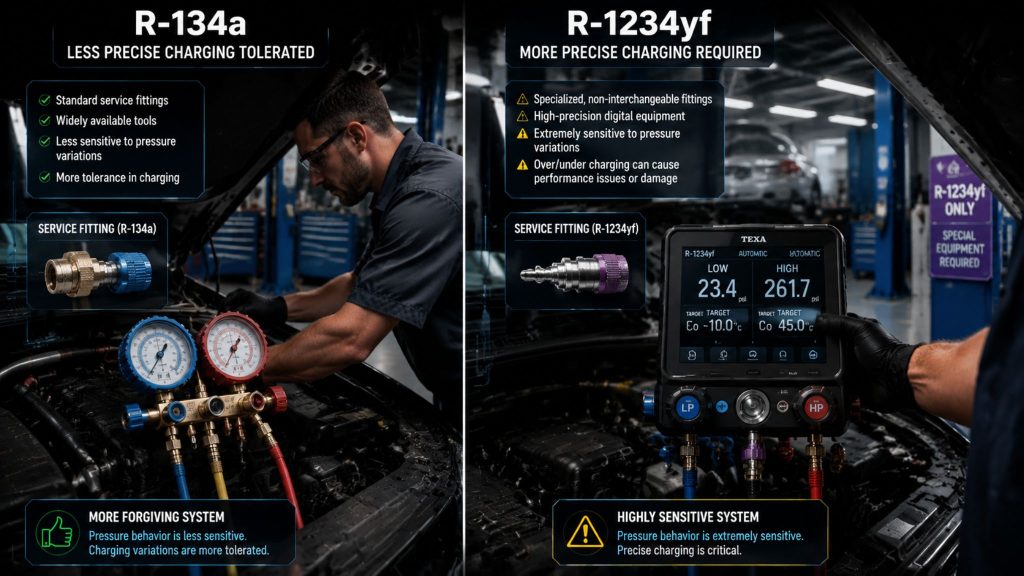
While both R-134a and R-1234yf are used in mobile A/C systems, they are fundamentally different in terms of handling, environmental standards, and service needs, as detailed below.
| Feature | R-134a | R-1234yf |
| Status | Older, common refrigerant | Newer, low environmental impact |
| Adoption | Widely used after R-12 phase-out | Adopted for tighter emissions regulations |
| Service | Familiar to many technicians | Requires more precise charging and cleaner service |
| System | Used for years | Found in newer vehicles |
| Pressures | Less precise charging tolerated | Pressure behavior and charging are more sensitive |
| Environmental | Higher environmental impact (GWP ~1430) | Lower environmental impact (GWP ~4) |
The Risks of Using the Wrong Refrigerant or Equipment
This is where expensive problems begin. The most common issue is not always a dramatic failure. Often, it starts with cross-contamination. That can happen when:
- The wrong recovery machine is connected
- Refrigerant identifiers are skipped
- Mixed refrigerant enters the system
- Incorrect oil or service fittings are forced into the process
- “Top-off” service is done without confirming system type
The High Cost of Refrigerant Cross-Contamination
Once the wrong refrigerant or contaminated refrigerant enters a late-model system, it can create chemical instability inside the system. Over time, that can contribute to:
- Internal acid buildup (specifically, trace amounts of highly corrosive hydrofluoric acid, which is a known risk according to industry safety standards)
- Seal degradation
- Poor lubrication
- Compressor stress
- Corrosion or moisture-related damage
We recently handled a fleet truck—a 2024 Peterbilt 579—that came in for a weak A/C. Our identifier showed 11% R-134a contamination in a factory R-1234yf system. This small error, likely from a single top-off at an unauthorized facility, required a full system flush and replacement of the oil-contaminated compressor seal. That contamination turned a minor recharge into a 10-hour repair and two days of unexpected downtime.
And once a shop’s machine is contaminated, that problem can spread to other vehicles if proper safeguards are not followed.
Steps for Correct R-1234yf System Service
A correct A/C service process for newer vehicles typically includes:
- Confirming the exact refrigerant type from the vehicle label.
- Using dedicated, non-cross-contaminating recovery and recharge equipment (such as the Robinair AC789 R-1234yf machine).
- Pulling a deep, correct vacuum to fully remove all moisture and air.
- Recharging the system to the precise manufacturer’s specification.
Why This Matters for Fleet Owners in Chandler Arizona
The extreme operational conditions of Arizona heat expose every weakness in a climate system. If your vehicles run routes through Chandler, the airport corridor, or the East Valley, they face demanding conditions:
- Extended periods of idling
- Repeated restarts throughout the day
- Constant operation under heavy heat loads
- Critical dependency on A/C for operator safety and productivity
These factors mean any underlying refrigerant issue is rapidly amplified and noticed.
A climate control system that is merely underperforming in a milder environment will fail catastrophically in this heat. We often find that what fleet owners diagnose as a “bad compressor” or “weak A/C design” is actually a consequence of prior incorrect refrigerant handling, cross-contamination, or a failure to recharge to precise manufacturer specifications.
Common Misconceptions About Refrigerant Transitions
- “If it cools, the refrigerant must be fine.” Not always. A contaminated or incorrectly serviced system can still cool temporarily before bigger issues show up.
- “R-1234yf is basically the same as R-134a.” It is not. The service process and contamination risk alone make that assumption dangerous.
- “Any A/C machine can handle either one.” That is one of the most expensive myths in the shop environment.
- “A simple top-off is harmless.” If the refrigerant type is wrong or the system has contamination, topping it off can make the repair more complicated—not less.
Prevent Repeat A/C Failures When to Get Your System Verified
If you’re seeing repeat A/C complaints across multiple newer vehicles, that’s usually the point where it makes sense to verify the process—not just symptoms.
At Copperhead Diesel Performance, the right next step is often a clean inspection of refrigerant type, system condition, and service history, especially for fleet vehicles operating in Chandler heat. That kind of confirmation helps prevent small A/C issues from turning into repeat downtime across multiple units. If you’re ready to ensure your fleet stays cool, visit us at 145 E Highland St, Chandler, AZ 85225.
Frequently Asked Questions
Can R-1234yf be mixed with R-134a?
No. Mixing refrigerants can contaminate the system and service equipment and lead to improper cooling and internal damage.
Why do 2026 models require more careful A/C service?
Because newer systems are designed around tighter refrigerant specs, dedicated equipment, and lower tolerance for contamination.
What happens if a shop uses the wrong machine?
It can contaminate the vehicle’s system and potentially affect the recovery machine itself, creating problems beyond one repair.
Is poor cooling always a refrigerant issue?
No. Poor cooling can also come from airflow problems, pressure control issues, sensor faults, or prior service mistakes.
Are fleet vehicles more at risk for refrigerant-related issues?
Yes, especially when they see heavy use, long idle time, frequent stop-and-go operation, and multiple service touchpoints over time.