Weak A/C at idle in Chandler is often caused by modern variable displacement compressors failing to increase output under high heat, rather than low refrigerant. This issue stems from hidden electronic glitches, like control solenoid (PWM) drift or sensor failure. Accurate diagnosis requires specialized tools to monitor control function, not just static pressure gauges.
The Hidden Cause of A/C Performance Drop at Idle
Unlike older cycling compressors, a variable displacement compressor continuously adjusts its internal capacity to meet system demand. When electronic inputs—such as sensor data, control valve function, or extreme heat load—interfere with this precise control, the result is reduced cooling efficiency without triggering a conventional failure code.
Arizona Heat Exposes A/C System Weaknesses
Chandler traffic and weather patterns include:
- Long idle times in traffic
- High ambient temperatures
- Heat reflecting off pavement
- Stop-and-go driving during peak hours
Those conditions push A/C systems to their limits. A system that performs “okay” in mild weather can feel inadequate fast when it’s 110°F and you’re sitting still.
We commonly see trucks and daily drivers that cool fine on the move but struggle at idle—not because they’re broken, but because the system can’t maintain capacity under heat load. For full heat-management reliability, remember that A/C is just one component of your overall cooling system.
Understanding Variable Displacement Compressor Operation
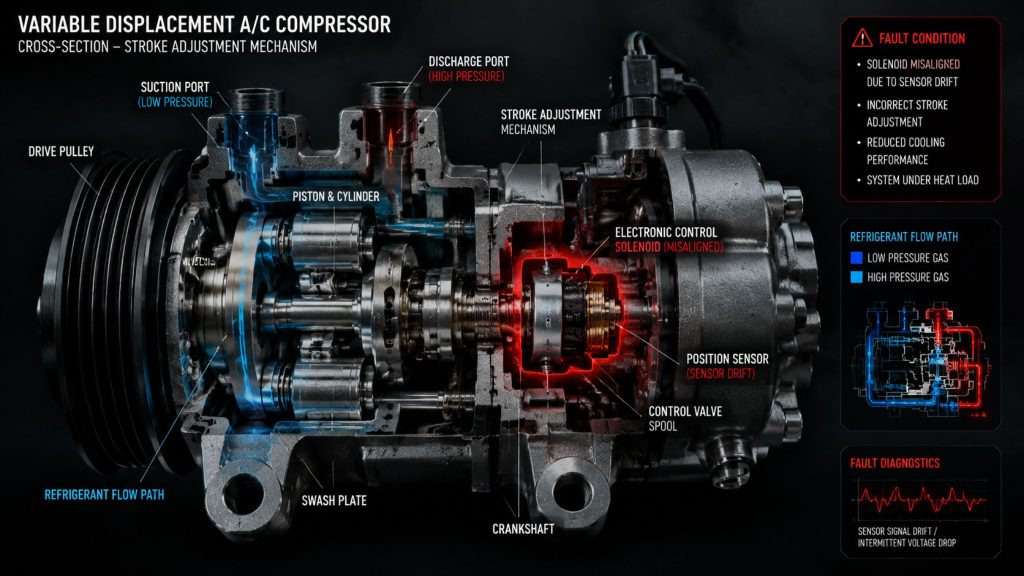
Instead of cycling on and off, this type of compressor adjusts its internal stroke. That means it can pump more or less refrigerant depending on demand.
The Role of the PWM Control Solenoid
A key component is a control solenoid, often managed by a pulse-width modulated (PWM) signal from the vehicle.
That signal tells the compressor how much displacement to use. In simple terms:
- High demand → more displacement → more cooling
- Low demand → less displacement → less cooling
This is more efficient and smoother than older systems, but it also means performance depends heavily on accurate inputs and proper control.
Consequences of Inaccurate Compressor Control
Even small issues can cause big changes in performance:
- Sensor drift can send incorrect pressure or temperature data
- A sticking control valve can limit compressor stroke
- Electrical issues can disrupt the PWM signal
- Heat load can overwhelm reduced compressor output at idle
The result? The system looks “normal” on a basic gauge but doesn’t cool effectively when you need it most.
AC System Failure Points Mimicking Weak Cooling at Idle
When AC struggles at idle, the issue often goes beyond a simple refrigerant leak. Common culprits include:
Faulty Compressor Control Valve
- Problem: Valve failure prevents the compressor from fully increasing its cooling output when demand rises at idle.
- Symptom: System can cool but fails to ramp up output when traffic slows.
Inaccurate Pressure and Temperature Sensors
- Problem: Faulty sensors trick the system into thinking required cooling is met.
- Symptom: A mismatch between the system’s perceived need and the actual heat the driver feels.
Improper Refrigerant Charge Masks Control Issues
- Problem: A control valve or sensor problem can produce symptoms identical to a low charge.
- Caution: DIY gauges often lead to mistakenly overcharging a system that actually has a control or sensor malfunction.
Separating Symptoms from the Real Cause
Weak A/C at idle is a symptom. The cause could be several things working together.
What makes diagnosis tricky? Because:
- Pressures can appear “within range”
- The compressor may still engage
- Cooling improves when driving
- No obvious warning lights appear
That combination leads many people to assume nothing is wrong—or to chase the wrong repair. A proper diagnosis looks at system behavior over time, not just static readings.
Common A/C Issues in Chandler Vehicles
In local conditions, we often see a pattern: A vehicle comes in with weak idle cooling. The refrigerant has already been topped off once or twice. Pressures look acceptable at first glance.
But under closer inspection, the system shows:
- Inconsistent compressor response
- Delayed cooling recovery after stopping
- High heat load at idle overwhelming reduced output
- Control valve or sensor irregularities
In other words, the system isn’t failing—it’s underperforming due to control limitations.
For example, last month a customer brought in a 2018 Ram 3500 that had been topped off three times. Our detailed diagnostic showed pressures were technically within spec (180psi static), but the PWM signal to the control solenoid was drifting 12% low at idle, confirming a sensor-induced underperformance rather than a leak.
Proactive Steps Drivers Can Take
You don’t need to overcomplicate it, but you do need to pay attention to patterns. Practical things to watch for:
- Does cooling drop only at idle?
- Does it recover quickly when driving?
- Has the system been recharged recently without improvement?
- Does the air feel “cool-ish” but not cold in heavy traffic?
If you’re seeing those signs, it’s worth looking deeper than just refrigerant levels. What should you avoid?
- Repeated “top-offs” without diagnosis
- Assuming the compressor is bad without testing control function
- Ignoring gradual performance decline
These systems reward accurate diagnosis and punish guesswork.
The New Reality of Modern A/C Diagnosis
Modern A/C systems are designed for efficiency, not simplicity, relying on precise control, accurate data, and balanced system conditions. If your A/C struggles hard at a stoplight but clears up when you get rolling, that’s a clue, not a riddle. When something drifts out of range—even slightly—the system may still run, but it won’t perform the way drivers expect.
These variable compressors don’t just quit the way the old clutch types did. Instead, they compensate, adapt, and sometimes just slack off without throwing a code. To diagnose this right, you need the heavy-duty tools and diagnostics. That means digital manifold gauges and scanners that can actually read the Pulse-Width Modulation (PWM) signal on that control solenoid. Understanding this difference is how we stop chasing leaks and nail the real problem the first time.
Ready for a Definitive Diagnostic?
Stop guessing and start cooling. Visit us for a definitive diagnostic to ensure your system is operating at peak performance. Copperhead Diesel Performance, 145 E Highland St, Chandler, AZ 85225.
Frequently Asked Questions
Why is my A/C cold while driving but warm at idle?
The variable displacement compressor is not increasing displacement enough at low engine speeds, especially when under high heat load.
Does this always mean my compressor is bad?
No. In many cases, the issue is related to control valves or sensor input—not complete compressor failure.
Can low refrigerant cause this?
Yes, but so can control issues. Both can produce similar symptoms.
Why doesn’t my gauge show a problem?
Basic gauges don’t show how the compressor is adjusting output over time.
Is this more common in newer vehicles?
Yes. Variable displacement systems are more sensitive to control accuracy than older designs.
Should I keep adding refrigerants?
No. Overcharging can make performance worse and increase system stress.