Modern automotive A/C systems operate on complex logic loops where sensor data overrides mechanical pressure. In Chandler’s desert heat, a faulty evaporator thermistor or sun-load sensor can trigger a system shutdown even when the refrigerant charge is close to correct. Master technicians use current scan tools to monitor these data streams in real-time, identifying electrical faults that traditional manifold gauges cannot detect.
We recently looked at a truck at our Highland St shop after the owner had already tried multiple A/C recharge attempts. The pressures looked close enough to suggest a refrigerant issue, but the vents were still blowing warm air. Scan data showed the evaporator thermistor was reporting a freezing condition even though the evaporator was not actually freezing, so the computer reduced compressor operation to protect the system. That is why we compare gauge readings with live HVAC sensor data before recommending a repair.
Why Relying on Refrigerant Recharge Alone Is a Trap
In a late-model diesel, hybrid, or electronically controlled vehicle, the A/C system depends on more than refrigerant pressure. When cooling fails, adding refrigerant may seem like the obvious first step, but it will not fix a logic-based fault inside the HVAC control system.
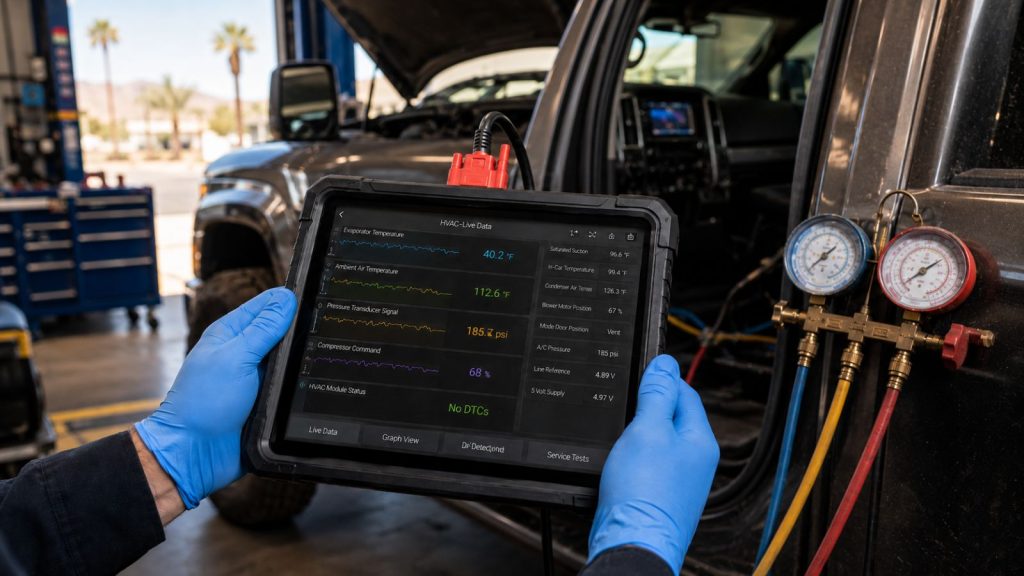
Manual manifold gauges still have value because they show physical pressure in the system. What they cannot show is whether the computer is commanding the compressor, reading the evaporator temperature correctly, or receiving accurate pressure and ambient temperature data.
- The Skewed Transducer: A pressure transducer can drift and report a value that does not match actual system pressure. When that happens, the HVAC module may reduce or disable compressor operation because it believes the system is outside a safe operating range.
- The Default State: Some modern systems default to reduced cooling, full heat, or compressor shutdown when they lose a key input from an ambient air temperature sensor, pressure sensor, or control module. The refrigerant charge may be close to correct, but the computer may not be giving the system permission to cool.
- The VDC Factor: Variable Displacement Compressors do not always click fully on or off. They adjust internal output based on an electronic command. If that command is weak, blocked, or based on bad sensor data, the compressor may appear active while still failing to move enough refrigerant for proper cabin cooling.
When Bad Sensor Data Tells the A/C System to Stop Cooling
Modern HVAC systems rely on a series of sensor inputs before the compressor is allowed to operate normally. If one sensor reports information that does not match real conditions, the HVAC control module may reduce cooling or disable compressor operation even when the refrigerant charge is close to correct.
We often see three sensor inputs create confusing A/C complaints during Chandler heat:
The Anti-Ice Guard on Evaporator Thermistors
This sensor sits inside the dash near the evaporator core. Its job is to monitor evaporator temperature so the system can prevent the core from freezing.
The Failure: If the thermistor is coated in dust, damaged, or developing an internal resistance fault, it may report a colder temperature than the evaporator is actually reaching.
The Result: The computer may think the evaporator is close to freezing and reduce or shut off compressor operation. From the driver’s seat, it feels like the A/C is low on refrigerant, but the system may actually be reacting to incorrect sensor data.
The Radiant Heat Adjuster on Sun-Load Sensors
These sensors usually sit on top of the dashboard near the windshield. In Chandler heat, sunlight through the glass can add a heavy load to the cabin cooling system.
The Function: The sun-load sensor measures solar intensity entering the cabin.
The Logic: As sunlight increases, the HVAC system may adjust blower speed, blend door position, and cooling strategy to help maintain cabin temperature.
The Failure: If this sensor is damaged, blocked by a dash mat, or reporting incorrectly, the A/C may feel acceptable in shade but struggle when the vehicle moves into direct afternoon sun.
Ambient Air Temperature Sensors
The ambient air temperature sensor is usually located near the grille or front bumper area. It tells the vehicle how hot it is outside.
The Conflict: If this sensor is damaged by road debris, wiring issues, or heat-soak effects, it may report a temperature that does not match actual conditions. If the vehicle thinks the outside air is much cooler than it really is, the HVAC logic may reduce compressor operation because it does not believe full cooling is needed.
How Bi-Directional Testing Separates Mechanical and Electrical A/C Faults
We do not rely on pressure readings alone when the A/C complaint points to a possible logic fault. Bi-directional scan tools let us communicate with the vehicle’s HVAC system, review live sensor data, and command certain components so we can see whether the problem is mechanical, electrical, or module-related.
- Forced Compressor Command: In some cases, we can command compressor operation through the scan tool and watch how the system responds. If vent temperature drops during the commanded test, that tells us the mechanical side may be capable of cooling and the fault may be related to sensor logic, wiring, or control strategy.
- Live Data Graphing: We graph sensor outputs while the system runs under heat load. A healthy sensor usually shows a smooth, believable pattern. A failing sensor may show dropouts, spikes, or sudden changes that help explain intermittent cooling problems.
- Module Networking Status: We also check for communication codes, often called U-codes. If the HVAC module loses communication with the engine control module or another networked system, compressor operation may be limited or disabled. In that case, adding refrigerant will not correct the communication fault.
Stop the Recharge Cycle and Check the Electrical Logic
If you have already added refrigerant and the vents are still blowing warm, the next step should be computerized HVAC diagnostics. Modern A/C systems rely on sensor data, module communication, and compressor commands, so a recharge will not solve the problem if the system is being limited by incorrect information.
Adding refrigerant without confirming the fault can also create new problems. If the system becomes overcharged, pressures can rise and compressor stress can increase. That is why we compare physical pressure readings with live scan-tool data before deciding whether the issue is refrigerant level, sensor input, wiring, compressor control, or HVAC module logic.
Getting a Diagnosis Beyond the Gauges
A warm A/C system after a recharge does not always mean the compressor has failed. In many cases, the vehicle may be responding to a faulty thermistor, inaccurate pressure transducer, weak command signal, sun-load sensor issue, or communication fault between modules.
Copperhead Diesel Performance provides computerized HVAC diagnostics, live sensor data analysis, bi-directional testing, and A/C electrical diagnostics at 145 E Highland St, Chandler, AZ 85225. If your A/C is still blowing warm after a recharge, scan-tool testing can help determine whether the system is actually low on refrigerant or whether the computer is being told not to cool.
Frequently Asked Questions
Can a faulty sensor cause a refrigerant recharge to trigger an A/C safety lockout mode?
Yes, this is common. If a sensor like the high-pressure transducer is faulty, adding more refrigerant can push the system into a safety lockout mode. The computer may limit or disable compressor operation to protect the system until the pressure or sensor fault is corrected.
Can a scan tool find a leak?
No, not directly. However, a scan tool can see if the low-pressure switch is open, confirming the system is empty. More importantly, it can tell us if the system thinks it’s empty due to a bad sensor, even when the charge is close to correct.
Is a sun-load sensor necessary for proper climate control?
Yes. In the Arizona desert, the sun-load sensor is vital. It measures solar intensity. Without it, your “Auto” climate control won’t know to increase cooling power when you drive out of the shade into the 105-degree afternoon sun.
Does a computerized diagnostic typically take about 45 minutes to an hour to complete?
Yes, usually about 45 minutes to an hour. This includes a full scan of the HVAC module, a bi-directional test of the actuators, and a live data review of the thermistors while the system is under thermal load.