Diesel A/C can fail in Chandler traffic even when the engine temperature gauge looks normal. Electronic fan clutches may be commanded by ECM logic, A/C high-side pressure, and condenser airflow demand, not coolant temperature alone. This guide explains how fan clutch data, pressure readings, and RPM verification reveal the real cause.
I’m watching the scan data on a 2022 PowerStroke at idle, and the numbers show something the dashboard temperature gauge cannot. The ECM is commanding high fan clutch engagement, but the fan speed is not matching that command. That mismatch can explain why the engine temperature looks normal while the A/C high-side pressure continues to climb. In Chandler heat, a freewheeling electronic fan clutch may not pull enough air across the condenser at idle, so the A/C system can reduce or shut off compressor operation to protect itself from excessive pressure.
Why Your A/C Quits Even When the Engine Stays Cool
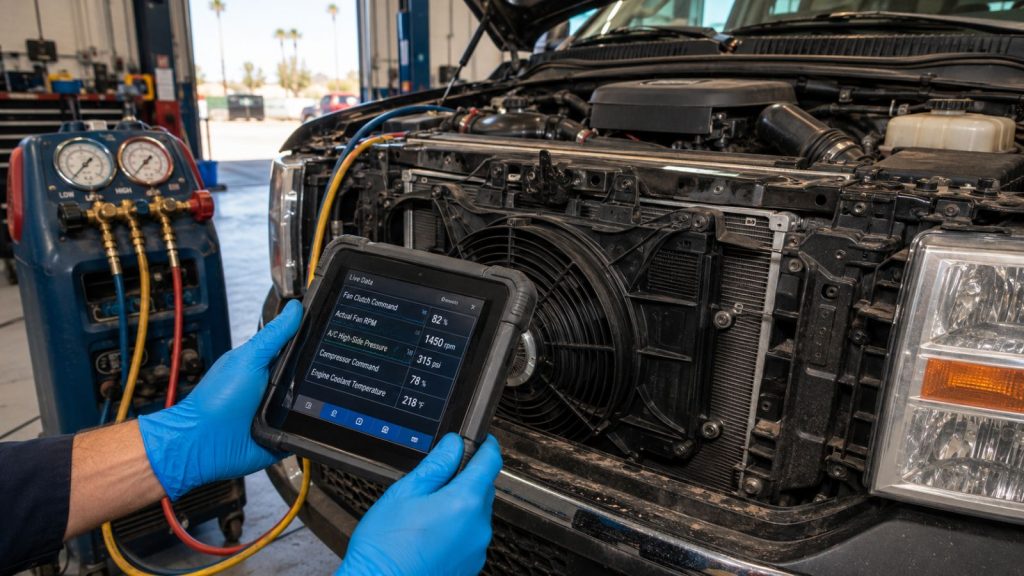
Most drivers think the fan is only there to control engine temperature, but the A/C system also depends on strong airflow through the condenser. If that heat is not pulled out of the condenser during idle or slow traffic, high-side pressure can rise quickly. We see trucks where the engine coolant temperature stays within normal range, but the A/C compressor reduces operation or shuts off because the system cannot shed heat fast enough.
The ECM monitors A/C high-side pressure and can command the electronic fan clutch through a Pulse Width Modulation (PWM) signal when more airflow is needed. If the clutch has an internal fault, fluid loss, or solenoid issue, it may not provide the engagement needed to move enough air across the condenser. The result is rising high-side pressure, weak vent cooling, and compressor protection logic stepping in before pressure gets excessive.
Ground-Effect Heat and the Loop 202 Gridlock
If you’ve ever been stuck in the Santan Freeway crawl near the Alma School Road exit, you know how quickly heat builds around the truck. During cooler spring months, natural airflow through the grille may be enough to help the condenser shed heat while the truck is moving. Once Chandler temperatures climb and traffic slows, that airflow drops off, and the A/C system depends much more on fan clutch engagement.
At a dead stop on Loop 202, the fan clutch becomes critical for condenser airflow. Without strong engagement, the condenser can hold too much heat and high-side pressure can rise. This is why your A/C may feel cold at highway speed but turn warm when traffic slows down. The fan may still be spinning, but it may not be pulling enough air to keep the system stable.
Looking Beyond the Coolant Gauge
The dashboard temperature gauge does not always tell the full story. Many modern gauges are buffered, meaning they may stay near the center while the ECM manages temperature and A/C pressure in the background. The engine may look stable, but the A/C system can still struggle if the condenser is not getting enough airflow.
We do not rely on the dash gauge alone, and we do not use the old paper test as proof of fan clutch performance. Modern electronic fan clutches use PWM control, so the better test is to compare what the ECM is commanding against what the fan is actually doing.
- Forced Command: We use a scan tool to command increased fan clutch engagement when the system allows it.
- RPM Verification: We compare actual fan speed against the commanded fan duty cycle.
- Command Versus Response: If the ECM is requesting high fan engagement but the fan speed remains low, the clutch may not be responding correctly.
At Copperhead Diesel Performance, we look at the communication between the sensors, ECM, and fan clutch hardware. If your diesel A/C cools well on the highway but gets warm in Chandler traffic, visit our shop at 145 E Highland St, Chandler, AZ 85225, where we can test the fan clutch logic and airflow response before replacing unnecessary parts.
Frequently Asked Questions
Can my fan clutch fail even if my engine is not overheating?
Yes. The fan clutch can be commanded by A/C high-side pressure demand before engine coolant temperature becomes a concern. If the clutch slips or does not respond correctly, A/C pressure can rise and the compressor may reduce operation or shut off even while engine temperature stays within normal range.
Does a failing electronic fan clutch have clear and noticeable symptoms?
Yes. A common sign is A/C that blows warm at stoplights or in traffic but cools better once the truck is moving. You may also notice weaker fan response during hot idle conditions, especially when the ECM is requesting more airflow but the fan is not matching the command.
Is the paper test a reliable way to check my fan?
No. Holding paper near the grille is not a reliable test for modern electronic fan clutches. These systems are controlled through Pulse Width Modulation, so proper diagnosis requires comparing commanded fan duty cycle, actual fan speed, and A/C pressure data with a scan tool.
Does a failed fan clutch cause permanent A/C damage?
Yes, it can contribute to damage over time. Safety controls are designed to protect the system from excessive pressure, but repeated high-pressure events can stress compressor seals, hoses, and other A/C components. Correct fan clutch diagnosis helps prevent unnecessary strain on the system.