R1234yf can cool well in diesel trucks, but it is less forgiving when charge weight, airflow, or moisture removal is incorrect. Chandler summer heat makes those small service errors easier to feel at the vents. This guide explains why accurate recovery, evacuation, and digital charging matter for modern diesel A/C performance.
R1234yf is not a weak refrigerant, but it does require more precise service than many older A/C systems. In modern diesel trucks, the refrigerant charge, condenser airflow, expansion valve behavior, and moisture control all have to work together. When one of those details is off, Chandler heat can expose the problem quickly.
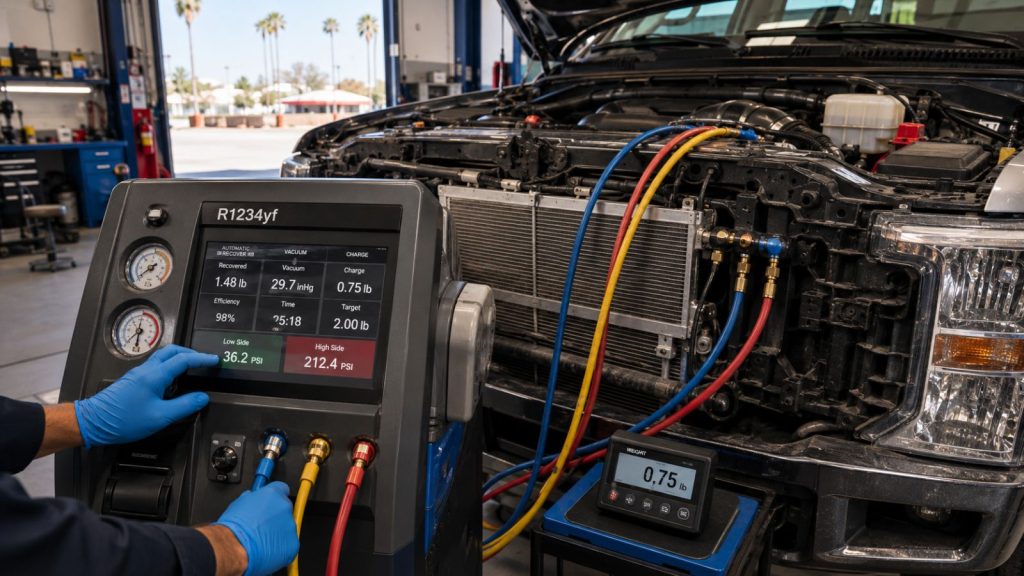
When we diagnose these systems, we do not judge the charge by pressure alone. We recover and measure what is in the system, evacuate moisture and air, then recharge by the exact weight listed for the vehicle. That process matters because R1234yf systems can lose cooling performance when they are undercharged, overcharged, contaminated, or serviced with the wrong equipment.
Why R1234yf Needs Accurate Charging in Arizona Heat
The move to R1234yf was driven largely by environmental requirements, not because drivers needed a colder refrigerant. It has different thermodynamic behavior than R134a, and modern systems are designed around those properties. That means the system can perform well, but only when the refrigerant mass, airflow, and component control are correct.
In Chandler summer heat, the condenser has to reject a large amount of heat while the truck may be idling, towing, or sitting in slow traffic. If the charge is too low, the evaporator may not have enough refrigerant flow to absorb cabin heat properly. If the charge is too high, pressure can rise and the system may become less efficient.
That is why a small charge error can feel much bigger in hot weather. A truck may cool acceptably during a cooler morning drive, then struggle later in the day when ambient temperature, engine bay heat, and stop-and-go traffic increase the load on the system.
Why Pressure Alone Does Not Confirm the Correct Charge
Older service habits often relied too heavily on gauge pressure. Pressure readings still matter, but they do not tell the whole story on a modern R1234yf system. Ambient temperature, fan performance, condenser condition, engine speed, cabin heat load, and sensor data can all change what the gauge shows.
A system can show pressure readings that seem reasonable while still having the wrong refrigerant mass. That is why charging by feel, by vent temperature alone, or by topping off with a can is not a reliable way to service these trucks. The correct charge is based on weight, not guesswork.
The better process is to recover the refrigerant and compare the recovered amount to the vehicle specification. From there, the system can be evacuated, checked for leaks or moisture concerns, and recharged with the correct measured amount. This gives the A/C system a stable starting point before pressure and vent temperature are evaluated.
How R1234yf Responds to Undercharge and Overcharge
Incorrect charge weight can affect R1234yf performance in more than one way. An undercharged system and an overcharged system may both create weak cooling, but they do it for different reasons.
- Undercharge: The system may not move enough refrigerant through the evaporator to absorb heat consistently. This can show up as weak cooling, changing vent temperatures, compressor cycling, or poor idle performance.
- Overcharge: Too much refrigerant can reduce condenser efficiency and raise high-side pressure. When pressure climbs, the control system may reduce compressor operation or protect the system, which can make the vents warm up even though the system is technically full.
Both conditions can feel similar to the driver. The A/C may work better while moving and struggle in traffic. That is why the diagnosis has to confirm charge weight, airflow, pressure behavior, and system commands instead of assuming the truck simply needs more refrigerant.
Why Chandler Traffic Exposes Refrigerant Charge Problems
Highway airflow can hide an A/C problem. When the truck is moving, air is forced through the grille and across the condenser, helping the system remove heat. In slow traffic near Loop 202, Alma School Road, or Chandler Fashion Center, that natural airflow drops off and the system depends much more on the fan, condenser condition, and correct refrigerant charge.
This is where R1234yf service precision matters. If the charge is slightly off, the fan clutch is weak, or the condenser is restricted with debris, the system may not reject heat fast enough while stationary. The vents may feel cold at road speed and then slowly warm up at a red light or during gridlock.
That symptom does not point to one cause by itself. It may be a charge issue, airflow issue, pressure sensor concern, compressor control problem, or expansion valve behavior. A proper test has to look at the full operating picture.
Why Digital Recovery, Evacuation, and Charging Matter
Dedicated R1234yf service equipment helps control the parts of the job that cannot be guessed accurately. The process gives the technician real data instead of relying on a gauge needle, vent feel, or a partial top-off.
- Recovery: Removes the refrigerant already in the system and measures how much was recovered.
- Evacuation: Pulls vacuum to help remove air and moisture before the system is recharged.
- Charging by Weight: Adds the specified refrigerant amount listed on the vehicle label or service information.
- Verification: Checks pressure behavior, vent temperature, compressor activity, and condenser airflow after the correct charge is installed.
Moisture removal is especially important. Air and moisture inside the system can affect pressure readings, cooling performance, and long-term reliability. Pulling vacuum is not just a formality; it helps prepare the system before the exact refrigerant charge is added.
The Risk of DIY Cans and Mixed Refrigerants
DIY cans can create problems because they usually do not verify the actual amount of refrigerant already in the system. Adding refrigerant without recovery and weighing can leave the system overcharged or still undercharged. Some products may also contain sealers or additives that complicate future diagnosis.
R1234yf systems also use dedicated fittings and service equipment to reduce the risk of cross-contamination. Mixing refrigerants can contaminate the system, create incorrect pressure-temperature behavior, and prevent proper recovery or service. It does not need to “destroy the system instantly” to become a serious service problem.
If a system has been topped off with the wrong refrigerant or additive, the first step is identification and safe recovery. From there, the technician can determine whether the system can be serviced normally or whether contamination has created additional repair steps.
Diesel A/C Performance Checks in Chandler Heat
When a diesel truck comes in with weak cooling, the answer is not always “add refrigerant.” We look at charge weight, leak history, condenser airflow, fan clutch operation, pressure sensor data, compressor control, and expansion valve behavior. R1234yf systems reward that kind of measured diagnosis.
A good A/C test should explain why the vents are warm, not just make them cold for a short time. If the system is leaking, overcharged, contaminated, or losing airflow at idle, a simple top-off will not solve the real issue. It may only hide the problem until the next hot afternoon.
For R1234yf diesel A/C concerns in Chandler heat, Copperhead Diesel Performance at 145 E Highland St, Chandler, AZ 85225 can verify refrigerant charge, pressure behavior, airflow, and system data so the repair is based on measured results instead of guesswork.
Frequently Asked Questions
Is R1234yf less effective than R134a in the heat?
Not exactly. R1234yf can provide strong cooling when the system is designed and charged correctly. It is better to say that R1234yf systems can be less forgiving of incorrect charge weight, poor condenser airflow, or moisture contamination, especially during hot idle conditions.
Can I use old R134a gauges on a newer R1234yf diesel truck?
No. R1234yf systems use different service fittings and require dedicated equipment. Even beyond the fitting difference, modern A/C diagnosis should not rely on pressure alone. The system needs proper recovery, evacuation, and charging by weight.
Does A/C that cools while driving but warms up in traffic mean the charge is wrong?
It can, but not always. That symptom may come from an incorrect refrigerant charge, weak condenser airflow, fan clutch problems, condenser restriction, pressure sensor issues, or compressor control logic. The charge weight should be verified along with airflow and pressure behavior.
Can I mix R134a into an R1234yf system?
No. Refrigerants should not be mixed. Mixing R134a with R1234yf contaminates the system, changes pressure-temperature behavior, and can prevent proper recovery or service. The correct refrigerant type should be identified before the system is charged or repaired.