Diesel A/C systems work harder during Loop 202 gridlock because low vehicle speed reduces condenser airflow while road heat and cabin load increase system pressure. This guide explains how fan clutch response, cooling stack cleanliness, recirculation mode, refrigerant charge accuracy, and pressure testing help maintain stable A/C performance in Chandler heat.
Diesel A/C performance is tested hardest when the truck is barely moving. At highway speed, airflow through the grille helps the condenser reject heat, but in traffic, the system depends more on fan clutch response, condenser condition, cooling stack cleanliness, and correct refrigerant charge. When we diagnose a truck that cools while driving but warms up at idle, we check high-side pressure, airflow, fan response, compressor command, and cabin heat load before assuming it only needs more refrigerant.
Why Diesel A/C Gets Warm When Traffic Stops
Most drivers notice the symptom before they know the cause. The A/C feels cold at 60 MPH, then the vents get warmer during a long red light, freeway crawl, or stop-and-go commute near Loop 202. That pattern often points to a heat rejection problem rather than a simple lack of refrigerant.
The condenser’s job is to release heat from the refrigerant. When the truck is moving, outside air is forced across the condenser fins. When traffic stops, the system loses that natural airflow and has to rely on the fan clutch or electric fan strategy to keep air moving through the front of the truck.
If airflow drops too far, high-side pressure can rise. When pressure gets too high, the control system may reduce compressor output or temporarily shut compressor operation down to protect the A/C system. To the driver, that feels like the truck suddenly lost cooling in traffic.
How Low Airflow Raises High-Side Pressure
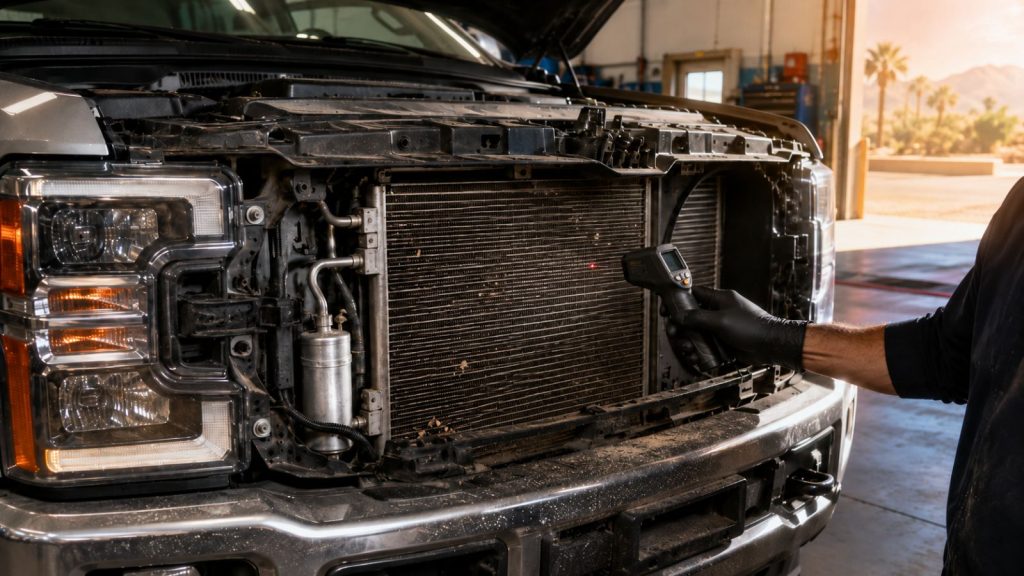
A diesel truck has more heat load around the front end than many smaller vehicles. The condenser may sit near the radiator, charge air cooler, transmission cooler, oil cooler, or other heat exchangers. This group of components is often called the cooling stack.
In slow traffic, air has to be pulled through that stack instead of being pushed through by road speed. If the fan clutch is weak, the condenser is dirty, or debris is packed between the cooling stack layers, the refrigerant may not release heat efficiently. The compressor then has to work against higher pressure.
This is why a pressure reading by itself is not enough. We need to see how pressure changes when the truck is idling, when fan command increases, and when the condenser is under real heat load. A system that looks stable during a short test drive may act very differently after several minutes of hot idle.
Why Chandler Road Heat Makes the Problem More Noticeable
In Chandler summer traffic, the A/C system is not only fighting hot air. Road-surface heat can warm the air entering the lower grille area, especially during long idle periods or slow freeway movement. That extra heat makes it harder for the condenser to cool the refrigerant.
This matters most when the truck is stationary. On the highway, the condenser receives a steady stream of moving air. In gridlock near Alma School Road, Price Road, or Chandler Fashion Center, airflow slows down and heat builds around the front of the truck.
That is when small weaknesses become obvious. A slightly restricted condenser, weak fan clutch, inaccurate refrigerant charge, or poor recirculation strategy may not cause much trouble in cooler weather, but it can show up quickly during a hot commute.
How Recirculation Reduces Cabin Heat Load
Recirculation mode can make a real difference during Phoenix-area rush hour. When the system is set to fresh air, the evaporator has to keep cooling hot outside air as it enters the cabin. In extreme heat, that adds a heavy load to the A/C system.
With recirculation on, the system re-cools air that has already been partially cooled inside the cabin. That can reduce the amount of heat the evaporator has to remove and may help stabilize vent temperature during long idle periods.
Recirculation will not fix a failing fan clutch, low refrigerant charge, or restricted condenser. It is not a substitute for repair. But when the system is working correctly, using recirculation in heavy traffic can reduce compressor load and help the cabin recover faster.
Practical A/C Strategies for Loop 202 Commuters
Good diesel A/C performance in gridlock depends on more than the temperature dial. These areas matter most when traffic slows and airflow drops:
- Use Recirculation in Heavy Traffic: Recirculation helps reduce the amount of hot outside air the system has to cool.
- Keep the Cooling Stack Clean: Dust, bugs, road debris, and bent fins can reduce airflow through the condenser and radiator area.
- Watch for Highway-Cold, Idle-Warm Symptoms: A/C that cools well while moving but warms up when stopped often points toward airflow, pressure, fan clutch, or charge concerns.
- Avoid Guess-Based Top-Offs: Adding refrigerant without recovering and measuring the charge can lead to overcharge, undercharge, or confusing pressure readings.
- Use Approved High-Idle Features Carefully: On trucks equipped with a factory-approved high-idle function, increased idle speed may improve airflow and compressor control, but it should be used only according to the vehicle’s setup and service guidance.
These habits help reduce heat load, but they do not replace proper testing when the system is already struggling.
What Fan Clutch and Condenser Testing Can Reveal
A weak fan clutch can make the A/C look like it has a refrigerant problem. If the fan does not pull enough air through the condenser at idle, high-side pressure may rise and vent temperature can increase. The truck may still cool well at road speed because natural airflow is hiding the weakness.
Condenser testing also matters. A condenser can look clean from the front while debris is trapped deeper in the cooling stack. Bent fins, dust buildup, or uneven temperature change across the condenser can reduce heat transfer and raise pressure during idle.
When we test these systems, we compare pressure behavior, fan response, condenser temperature changes, and vent output together. That gives a clearer answer than looking at one reading by itself.
Diesel A/C Optimization for Chandler Heat
Diesel A/C optimization starts with confirming the basics. The refrigerant charge should be correct, the condenser should be able to reject heat, the fan clutch should respond properly, and the compressor should operate within the system’s expected range.
If one of those areas is off, the system may still feel cold in the morning or while driving at speed. The real test comes during hot idle, slow traffic, and repeated stops. That is when weak airflow and high heat load expose problems that a short drive may not reveal.
For diesel A/C concerns in Chandler traffic, Copperhead Diesel Performance at 145 E Highland St, Chandler, AZ 85225 can check refrigerant charge, fan clutch response, condenser airflow, pressure behavior, and system data before parts are replaced.
Frequently Asked Questions
Is A/C getting warm only when stopped in traffic a sign of an airflow issue?
Yes, it can be. A/C that cools well while driving but warms up when stopped often points toward reduced condenser airflow, weak fan clutch response, condenser restriction, or high-side pressure concerns. The refrigerant charge should also be verified before assuming the system only needs a top-off.
Is it normal for my A/C compressor to cycle rapidly in extreme heat?
No, rapid cycling should be inspected. In hot idle conditions, repeated compressor cycling may happen when pressure, charge level, airflow, sensor data, or control logic is outside the expected range. The system may be protecting itself, but the cause still needs to be diagnosed.
Does road heat affect diesel A/C performance in traffic?
Yes. Road heat can raise the temperature of the air entering the lower grille area, especially during long idle periods or slow freeway traffic. That makes condenser airflow and cooling stack cleanliness more important because the system has less help from natural road-speed airflow.
Can I clean my own A/C condenser to improve cooling?
You can gently rinse surface dust from the condenser area, but avoid high-pressure washing because it can flatten delicate aluminum fins. Deep debris trapped between cooling stack components may require careful inspection and cleaning so airflow can pass through the condenser and radiator area properly.