In Chandler heat, working A/C is more than a comfort feature. A weak or non-functional climate control system can affect buyer confidence, condition rating, and trade-in value because dealers may deduct expected diagnostic and repair costs before resale. This guide explains how A/C problems influence diesel truck appraisals.
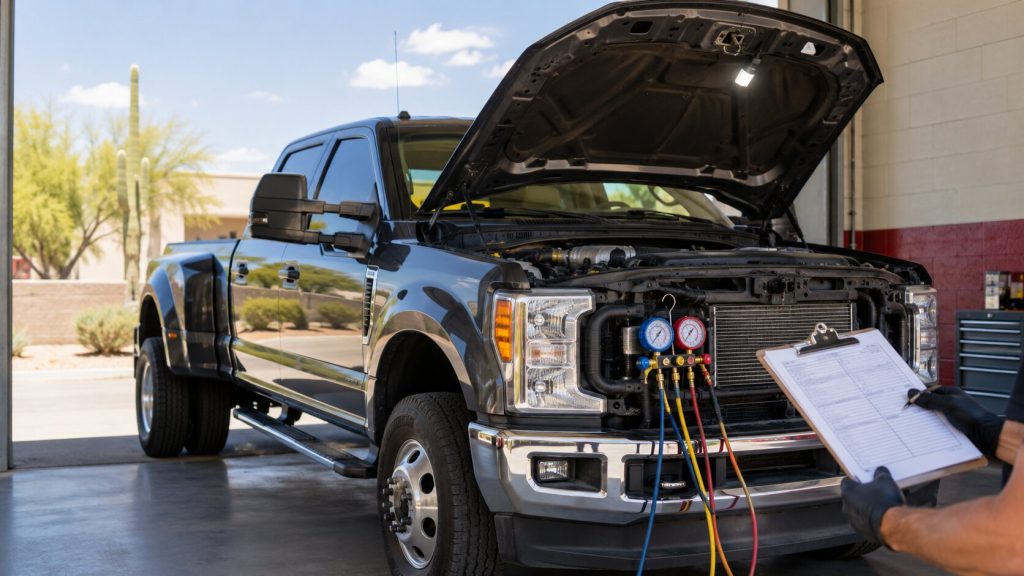
A diesel truck can look clean, run well, and still lose value if the A/C blows warm during a Chandler summer appraisal. Working climate control affects comfort, drivability, and resale readiness, so buyers may reduce the offer when A/C repair risk is unclear. Before sale or trade-in, we check refrigerant charge, pressure behavior, compressor command, condenser airflow, fan operation, stored HVAC faults, leak signs, and cooling at idle and road speed to see whether the issue is minor service or a larger repair concern.
Why Working A/C Matters More in Chandler Trade-Ins
In mild climates, a weak A/C system may be treated like a comfort issue. In Chandler, it is much harder to ignore. A truck that cannot cool the cab during summer heat may be harder for a dealer to retail and less appealing to private buyers.
That matters during appraisal because the buyer is not only judging the truck’s current condition. They are also estimating what it may cost to make the vehicle ready for resale. If the A/C is weak, noisy, intermittent, or completely warm, the appraiser may assume the vehicle needs diagnosis and repair before it can be confidently sold.
This does not mean every A/C issue reduces value by the same amount. The impact depends on the truck, mileage, trim level, repair history, market demand, and the actual failure. A simple cabin filter restriction is very different from a leaking evaporator or contaminated compressor system.
How Appraisers View Weak or Broken Climate Control
A/C performance can influence the condition rating of a used truck. If the vehicle has a major comfort or mechanical system that does not work correctly, the buyer may classify it less favorably or deduct expected repair cost from the offer.
During an appraisal, the A/C concern may show up in several ways. The vents may blow warm at idle, the cooling may fade during a test drive, the compressor may make noise, or the system may have stored HVAC-related fault codes. In some trucks, an appraiser or technician may also check live data to see whether the compressor is being commanded, whether pressure readings make sense, and whether the system is cycling normally.
The key point is simple: a weak A/C system creates uncertainty. Uncertainty usually becomes a deduction because the next owner or selling dealer does not want to inherit an unknown repair.
Why a Quick Recharge May Not Protect Your Appraisal
A refrigerant top-off may make the vents feel colder for a short time, but it does not prove the system is healthy. If the truck has a leak, a weak compressor, restricted condenser, failing expansion valve, electrical fault, or poor fan airflow, the cooling complaint may return quickly.
Modern A/C systems are also sensitive to charge amount. Too little refrigerant can reduce cooling and oil circulation, while too much refrigerant can raise pressure and stress components. Adding refrigerant without testing can make the system harder to diagnose and may create pressure behavior that looks suspicious during inspection.
Before a trade-in or sale, the better approach is to verify the cause. Recovery and recharge by weight, leak detection, pressure testing, scan-tool data, and vent temperature checks give a clearer picture than a temporary recharge can.
Common A/C Problems That Can Reduce Truck Value
Not every A/C problem carries the same resale impact. Some issues are simple and inexpensive compared with major internal failures. Others can create larger appraisal deductions because they require more labor, more parts, or deeper disassembly.
| A/C Concern | Why It Matters During Appraisal | Possible Value Impact |
| Dirty cabin filter or weak airflow | May make the A/C feel underpowered even if the refrigerant loop is working | Low to moderate |
| Low refrigerant charge | May point to a leak that needs confirmation before resale | Moderate |
| Weak fan or poor condenser airflow | Can cause warm air at idle or in traffic, especially in Chandler heat | Moderate |
| Failing expansion valve or restriction | May create unstable pressures, poor cooling, or repeat complaints | Moderate to high |
| Leaking evaporator core | Often requires dash disassembly and significant labor | High |
| Compressor noise or internal contamination | May require major A/C repair and system cleanup | High |
These are examples, not guaranteed dealer deductions. The actual value impact depends on the truck and the diagnosis. Still, the pattern is consistent: the more uncertain or labor-intensive the A/C repair looks, the more likely it is to affect the offer.
Repair Cost vs Trade-In Deduction: What to Consider
A dealer or buyer may not deduct the exact same amount a local repair shop would charge. Their offer may include diagnostic time, parts, labor, reconditioning risk, and a margin for unexpected findings. That is why an unrepaired A/C issue can feel more expensive at the trade-in desk than it would have been if diagnosed earlier.
For example, a truck with a weak A/C complaint could have a simple airflow issue, but the appraiser may not know that during a quick inspection. If the vents are warm and the cause is unknown, the buyer may protect themselves by assuming a larger repair. A documented diagnosis can reduce that uncertainty.
This is where pre-sale A/C testing can help. Even if the owner chooses not to repair everything, knowing whether the problem is a low charge, a sensor fault, a condenser airflow issue, or a major leak gives them a stronger position before negotiating.
How A/C Diagnostics Can Support Resale Confidence
A proper A/C inspection gives the owner more than a cold-or-warm answer. It explains what the system is doing and what it may need. That matters when preparing a diesel truck for trade-in or private sale.
A strong pre-sale A/C check may include refrigerant recovery and charge verification, leak detection, high-side and low-side pressure readings, vent temperature testing, compressor command data, fan operation checks, condenser airflow inspection, and HVAC module scan data. These results help separate minor maintenance from major repair risk.
If the truck cools well after proper service, the owner can present it with more confidence. If the system needs repair, the owner can decide whether to fix it before sale or account for it honestly during negotiation.
Why Chandler Test Drives Expose Borderline A/C Systems
A truck may feel acceptable during a short morning drive, then struggle during afternoon traffic. Chandler heat makes marginal A/C performance easier to notice because the system has less room for error. Hot pavement, slow traffic, high cabin load, and low condenser airflow all make the system work harder.
This is why an appraisal test drive can expose a borderline system. If the truck cools only at highway speed but warms up at idle, the concern may involve condenser airflow, fan operation, charge accuracy, or compressor performance. If cooling fades after several minutes, the issue may involve pressure behavior, expansion valve control, icing, sensor data, or refrigerant flow.
A/C performance should be tested under conditions that match how the truck will actually be used. In Chandler, that means paying attention to idle cooling, stop-and-go performance, and heat-soak behavior, not just vent temperature during a quick cold start.
A/C Diagnostics Before Selling or Trading Your Truck
Before selling or trading a diesel truck, A/C diagnostics can help protect value by reducing unknowns. A buyer is more likely to penalize an A/C system when the cause is unclear. A confirmed diagnosis gives the owner a better understanding of the repair path and whether service should be completed before appraisal.
This does not mean every truck needs major A/C repair before trade-in. Sometimes the issue is a dirty cabin filter, incorrect charge, weak airflow, or a sensor problem. Other times, testing may uncover a leak, failing compressor, or internal restriction that should be addressed before it affects the offer.
For diesel truck A/C inspections before sale or trade-in, Copperhead Diesel Performance at 145 E Highland St, Chandler, AZ 85225 can check cooling performance, refrigerant charge, pressure behavior, leak signs, fan operation, compressor control, and HVAC fault data before you walk into an appraisal.
Frequently Asked Questions
Does a slow A/C leak really lower my trade-in value?
Yes, it can. A slow leak may reduce trade-in value if the A/C is blowing warm, losing performance, or showing signs that repair will be needed before resale. The size of the deduction depends on the truck, the market, and the confirmed repair needed.
Can an appraiser tell if I used a store-bought refrigerant recharge can?
Sometimes. A temporary recharge may improve cooling for a short period, but it may not hide a leak, pressure imbalance, overcharge, compressor noise, or stored HVAC fault. If the system does not perform correctly during inspection or a test drive, the concern can still affect the offer.
Why can a trade-in deduction be higher than a repair estimate?
A trade-in deduction may include more than the expected part cost. Buyers may factor in diagnostic time, labor, reconditioning risk, downtime, and the possibility of additional hidden problems. That is why it is helpful to know the actual diagnosis before negotiating.
Will clearing diagnostic trouble codes hide a failing A/C system?
No, not reliably. If the underlying fault is still present, the code may return during operation or the A/C may still blow warm during the inspection. Clearing codes without fixing the cause does not correct low refrigerant, poor airflow, compressor problems, or sensor faults.