The chemical breakdown of compressor oil and internal metal components creates an acidic, black sludge that irreversibly contaminates the entire heavy-duty air conditioning loop. When this catastrophic failure occurs, a complete closed-loop solvent flush and total component replacement become mechanically mandatory to prevent the instant destruction of newly installed parts.
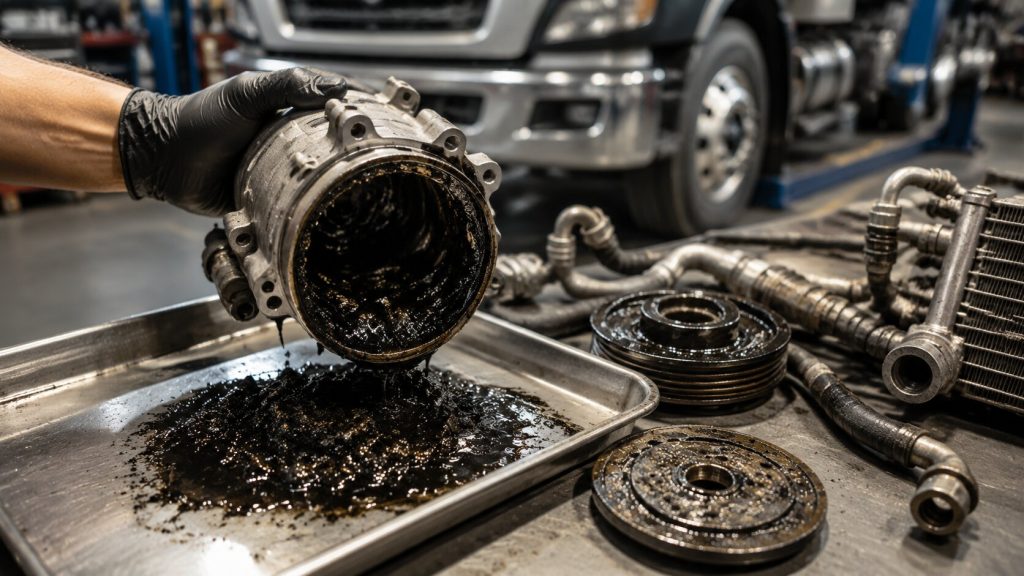
Just recently at our facility, I cut open a localized liquid line and watched jet-black, foul-smelling goo pour directly onto the workbench. This chemical sludge is referred to in the industry as Black Death, and it represents the absolute worst-case scenario for heavy-duty truck owners trying to survive the extreme July heatwaves in Chandler.
The Chemical Breakdown and Shrapnel Migration
When high-discharge temperatures cross 250 degrees Fahrenheit under heavy towing loads, the synthetic PAG oil undergoes severe sludge polymerization. Moisture and air infiltration force the oil to cross-link into a highly acidic, tar-like compound that strips away all mechanical lubrication, triggering immediate internal mechanical disintegration. Once the compressor’s internal swashplate shatters, the system rapidly pumps sub-micron aluminum grit and jagged iron shards directly into the high-side line network at 400 psi.
This violent shrapnel migration permanently wedges fine metal debris inside the parallel-flow micro-tubes of the condenser, which feature channels far too narrow to ever be flushed clean. The lingering metallic grit also settles directly onto the tiny pin of the Thermal Expansion Valve, causing the metering assembly to instantly seize. If a technician simply bolts on a lone, new compressor while ignoring this hidden grit, those abrasive shards immediately migrate backward, scoring the new cylinder walls and causing a catastrophic secondary failure within hours.
System Decontamination Protocol vs Component Replacement
When Black Death strikes, executing a simple single-component mechanical swap is impossible, as the entire line network must be completely chemically overhauled. The table below outlines the strict differences in repair scope between a standard component fix and a complete closed-loop decontamination protocol.
| System Status Metric | Standard Component Leak Scope | Catastrophic Black Death Scope | Secondary Asset Impact |
| Compressor Unit | Replace single failing assembly | Complete scrap and factory upgrade | Mandates deep core verification |
| Condenser Assembly | Routine chemical line flush | Mandatory disposal and replacement | Micro-tubes harbor hidden shards |
| Metering Valve | Inspected and retained | Mandatory scrap and replacement | Internal screens trap fine grit |
| Refrigerant Hoses | Retained with fresh seals | High-extraction chemical solvent flush | Requires full chemical rinsing |
High Extraction Solvent Flushes
To shield your fresh mechanical investment from lingering debris, our team executes a meticulous multi-stage chemical decontamination sequence before installing new hardware. We push aggressive chemical solvents through the salvageable hard lines under extreme pressure, breaking up the baked-on tar and purging the abrasive metal shards from the interior walls of the hoses.
During this process, we entirely remove the contaminated compressor, condenser, and expansion valve assemblies, treating them strictly as scrap metal to ensure zero cross-contamination. After installing the new original equipment components, we utilize advanced factory-level scan tools to clear all internal climate control codes, successfully restoring the factory pressure baselines so the new system operates flawlessly under the high-load conditions of the Loop 202 freeway.
Heavy Duty Climate Evaluation Center
The high-extraction solvent flushes, parallel-flow condenser replacements, and chemical fluid audits detailed in this technical guide dictate the preventative service standards at Copperhead Diesel Performance. All heavy-duty AC system evaluations and closed-loop decontaminations are executed at the service facility located at 145 E Highland St, Chandler, AZ 85225.
Frequently Asked Questions
Can standard shop solvents clear sludge out of a condenser?
No. Modern parallel-flow condensers use ultra-thin micro-tubes that measure less than a millimeter wide. Once acidic polymer sludge and aluminum shrapnel pack inside these tiny channels, no flushing chemical can dislodge the debris, making total component replacement mandatory.
Why does a failure smell so bad when you open the lines?
It is because the extreme operating temperatures over-cook the synthetic PAG oil. When the oil breaks down alongside moisture and air, it cross-links into an acidic varnish that emits a distinct, pungent, burnt-chemical odor indicating total fluid contamination.
Will a professional multi-gas refrigerant identifier detect contamination early?
Yes. High-end refrigerant identifiers flag abnormal oil moisture levels and foreign chemical signatures before the compressor locks up solid. Catching this early allows us to flush the lines before the pistons shatter and disperse shrapnel through the loop.
Can a compressor be rebuilt after suffering a total lockdown?
No. A catastrophic Black Death failure means the internal swashplates, pistons, and cylinders have ground themselves down into metal shavings. The structural housing is physically scored and structurally compromised, meaning the entire unit is scrap metal and must be fully replaced.
How fast will a contaminated line ruin a newly installed compressor?
Almost instantly. If residual metallic grit is left inside the hard lines, it will migrate straight into the new compressor’s suction port within the first few miles of driving, immediately scoring the new pistons and voiding your parts warranty.