Modern variable displacement compressors use pulse-width modulated (PWM) control valves to precisely adjust internal swashplate angles and piston strokes. This precise control reduces the parasitic mechanical load on your heavy-duty diesel engine, maximizing fuel economy even when you’re pulling loads through triple-digit Chandler heat.
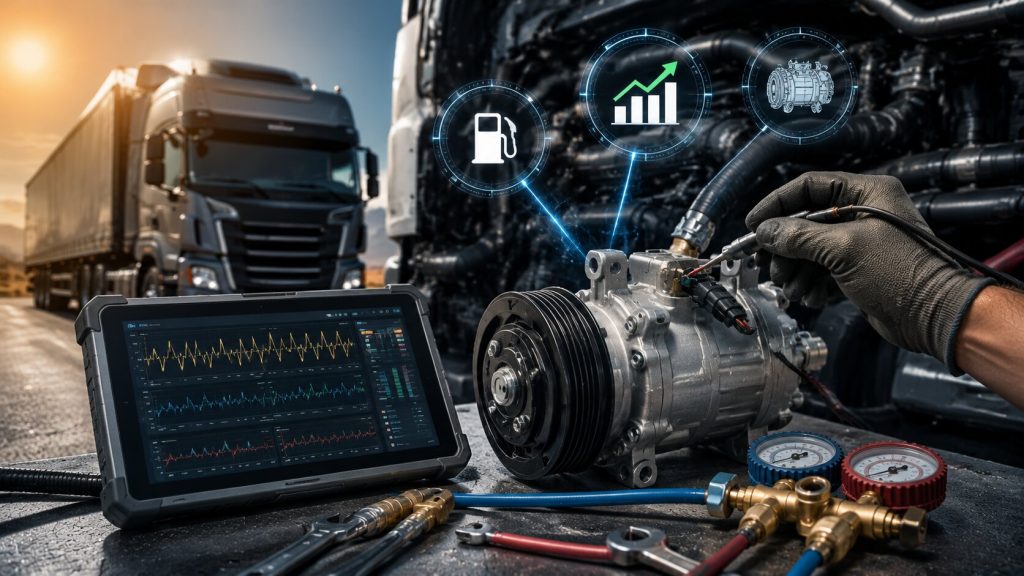
When a heavy-duty diesel truck rolls into our bay blowing lukewarm air, the diagnostic approach is completely different than it used to be. Legacy systems had obvious mechanical failures—a squealing belt or a clunking clutch. Modern electronic variable displacement compressors (EVDC) don’t use traditional clutches. When they fail, it’s an electrical issue, and it’s subtle. Identifying these faults requires putting an oscilloscope on the harness for advanced wave diagnostics, not just throwing hard parts at the truck and hoping for the best.
The Internal Engineering of Electronic Swashplate Control Valves
Traditional automotive air conditioning compressors operate as purely binary mechanical units: they are either running at full capacity or turned off completely. They rely on a heavy electromagnetic clutch to lock the pump pulley to the main drive belt, forcing the internal pistons to pump a massive, static volume of chemical gas into the cooling lines.
Variable displacement platforms replace binary mechanical units with a permanently locked drive pulley that spins without a clutch. Volume is regulated by adjusting an internal swashplate’s angle within the pump crankcase. By modulating internal pressures, the swashplate either straightens to nearly eliminate piston strokes during low cooling demand or tilts to maximize displacement when temperatures rise.
How Pulse Width Modulation Tames Heavy Diesel Engine Loads
- PWM Current Delivery: The PCM sends a high-frequency, 400 Hz pulse-width modulated signal to the ECV solenoid.
- Variable Duty Cycle: Adjusting the signal’s “on-time” alters the magnetic field and internal pressure to tilt the swashplate.
- Shockwave Elimination: Electronic control removes high-torque clutch shocks, protecting belts, water pumps, and bearings.
Transitions are seamless. When towing, the computer reduces the swashplate angle to decrease crankshaft drag, preventing engine lugging.
Quantifying Parasitic Drag Reductions and MPG Benefits
Electronic variable systems drastically cut the continuous parasitic load placed on your heavy diesel powertrain. A legacy fixed pump draws maximum horsepower all the time, forcing the engine to burn extra fuel just to fight the cooling loop’s mechanical resistance.
Here is the real-world operational impact of shifting compressor stroke percentages relative to power draw and fuel economy:
| Compressor Swashplate Stroke Length | Active Mechanical Parasitic Load | Estimated Diesel Fuel Economy Penalty | Active Mechanical System Impact |
| Minimum Stroke Capacity (1% to 5%) | Less than 0.5 Brake Horsepower. | Under 0.5% total fuel consumption drop. | Pulley spins freely; minimal internal piston movement. |
| Moderate Operational Stroke (40% to 50%) | 2.5 to 4.0 Brake Horsepower. | 1.5% to 2.5% reduction in overall MPG. | Smooth, continuous cooling; balanced loop pressures. |
| Maximum Displacement Stroke (100%) | 8.0 to 12.0 Brake Horsepower. | 4.0% to 6.5% drop in total fuel efficiency. | Full output capacity to combat extreme cabin soak heat. |
If an internal electronic valve fails or sticks due to oil breakdown, it frequently traps the swashplate at minimum stroke. This leads to confusing diagnostics for inexperienced technicians: while the pulley spins and lines appear intact without dashboard warnings, the cabin won’t cool because the pump moves insufficient mass.
Bench Diagnosing Weak Control Solenoids at Copperhead Diesel Performance
It makes me furious to watch amateur repair shops or retail chain operations condemn an entire, expensive compressor assembly when only the inexpensive, external electronic valve has failed. Our technical protocol at Copperhead Diesel Performance is built on rigorous component-level validation:
- Signal Waveform Tracking: We connect high-speed digital storage oscilloscopes to the active ECV wiring harness to verify the incoming 400 Hz PWM signal from the PCM.
- Pressure Delta Mapping: We connect modern digital manifolds to watch how local pressures react to manual changes in the commanded duty cycle percentage on our scan tools.
- Valve Mechanical Auditing: If the electrical wave signal looks flawless but system pressures remain completely flat, we extract the isolated valve stem to check for internal mechanical sticking.
This clinical approach saves our clients from paying for complete system overhauls when a targeted, valve-level calibration service is all that is required to restore freezing air.
The Ultimate Pre Summer Shield for Your Truck
Don’t let a malfunctioning variable compressor rob your fuel economy on Loop 202. Uncalibrated valves cause engine drag and weak cooling when you need it most.
Is your truck’s variable compressor optimizing your engine load, or is a hidden electrical valve defect quietly robbing you of horsepower and fuel economy? Let’s trace your system’s live duty cycle waveforms today and restore maximum cooling efficiency before your next haul.
Stop by Copperhead Diesel Performance at 145 E Highland St, Chandler, AZ 85225.
Frequently Asked Questions
Why don’t modern variable displacement compressors use a traditional clicking clutch?
Eliminating the mechanical clutch allows the system to change displacement smoothly from one to one hundred percent capacity. This removes the harsh torque shock waves from the engine belt loop, optimizing fuel economy and extending the service life of all front accessory drive components.
Can a faulty electronic control valve cause my truck to burn excessive diesel fuel?
Yes. If the internal ECV sticks mechanically in a high-displacement position, the internal swashplate stays anchored at maximum stroke length even when cabin cooling demands are low. This forces the engine to fight maximum parasitic loads continuously, hurting your overall fuel mileage.
Will a standard dashboard check engine light turn on if the AC control valve fails?
No. Most vehicle powertrain computers only monitor major electrical shorts or open circuit connections. If the valve stem suffers an internal mechanical seizure or fluid restriction, the system will continue to cycle blindly without triggering a standard diagnostic trouble code on your dash.
How does a high-frequency 400 Hz PWM signal actually move an internal compressor valve?
The valve contains a highly responsive electromagnetic solenoid. The vehicle’s computer changes the active duty cycle percentage of the electrical wave, which alters the overall magnetic force pulling on the internal valve stem to seamlessly change internal crankcase pressures.
Can you replace just the external electronic control valve without replacing the whole compressor?
Yes. If our digital storage oscilloscope confirms that the internal compressor pistons and swashplate pins are structurally healthy, we can evacuate the system, unbolt the weak external valve assembly, and install a fresh OEM solenoid component to save you thousands in hardware costs.