Preventative fleet air conditioning audits and precise refrigerant mass balancing isolate hidden cooling loop deficits, preventing sudden compressor failures and auxiliary component damage. When commercial heavy-duty trucks confront extreme triple-digit desert heatwaves across Chandler, these hidden deficits rapidly transform into expensive logistical delivery route downtime. Waiting until peak summer to address fleet cooling issues guarantees that minor AC imbalances escalate into catastrophic system collapses under extreme operating pressures.
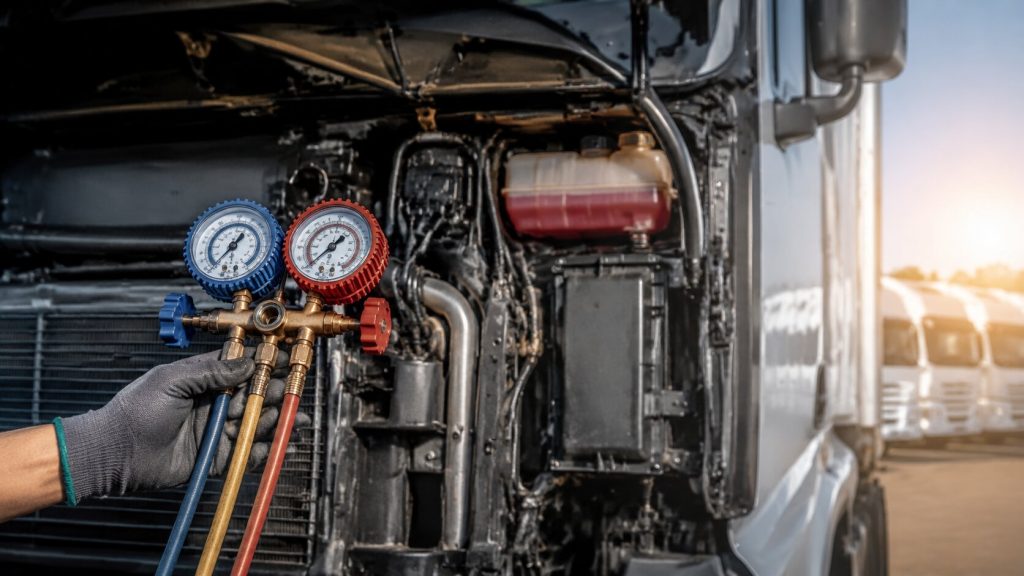
Waiting until peak summer to address fleet cooling issues is a costly mistake. Minor AC imbalances manageable in spring quickly trigger catastrophic compressor failures and delivery delays under extreme desert heat. To avoid expensive logistical disruptions and driver overtime, commercial operators must prioritize proactive, data-driven preventative cooling audits to ensure vehicle reliability throughout the intense summer shipping season.
The Logistics of Refrigerant Mass Balancing for Commercial Trucks
Modern medium- and heavy-duty delivery platforms rely on highly precise chemical loads to maintain stability. When a delivery truck or hotshot transport vehicle is missing even 10% to 15% of its total factory fluid weight, the entire refrigeration loop slips out of its designed equilibrium.
Low fluid mass slows refrigerant gas velocity, preventing essential lubricating oil from returning to the pump. This low-charge state causes overheating and constant compressor short-cycling, creating a parasitic engine load that cuts fuel efficiency by up to 12% before cooling fails entirely. Balancing the charge by precise weight maintains the lubrication cycle and protects components from premature failure.
The CFM Decay Factor Catching Weak Condenser Fans Before Summer
The front condenser assembly on a commercial vehicle is its primary defense line against extreme high-side pressure buildup. In our local climate, this assembly faces two severe structural challenges:
- Caliche Fin Infiltration: Trucks operating around industrial hubs or regional construction zones draw fine desert dust into the front grille. This dust mixes with moisture to form a thick, insulating caliche crust across the aluminum fins, severely undercutting the system’s heat rejection capacity.
- Airflow Velocity Loss: When a vehicle is trapped idling stationary in heavy traffic, it cannot rely on vehicle-speed ram-air. It relies entirely on the condenser fan clutch to draw air through the core.
Our fleet audits go beyond visual checks; we use digital anemometers to measure condenser fan CFM output. If airflow falls below factory specs due to fan clutch issues or damaged blades, head pressures can spike above 400 PSI during idling. Detecting this early allows us to fix restrictions before extreme heat causes compressor lockup.
Calculating the Real Cost of Unscheduled Fleet Breakdowns
Operating on a reactive “fix it when it breaks” maintenance model is a dangerous strategy for any commercial fleet logistics business. When an asset suffers a sudden, catastrophic cooling system breakdown while out on a delivery run, the immediate financial consequences scale far beyond the cost of the mechanical parts.
The table below outlines the real-world operational difference between a structured, preventative fleet audit program and an emergency mid-season road rescue failure:
| Operational Asset Metric | Preventative Fleet Maintenance Audit | Emergency Roadside Breakdown Failure |
| Upfront Service Expense | Low-cost scheduled inspection and balancing. | Premium emergency towing and replacement fees. |
| Vehicle Asset Downtime | 45 minutes of pre-planned off-peak shop time. | 2 to 4 days of lost field production. |
| Component Repair Scope | Basic front seal or port needle replacement. | Full system flush and compressor scrap. |
| Secondary Business Impact | Zero disruption to shipping schedules. | Missed delivery slots and driver overtime. |
| System Lifecycle Protection | Maximizes original equipment longevity. | High risk of hidden loop cross-contamination. |
A single unscheduled mechanical failure during a peak delivery window can easily wipe out the entire monthly operating margin for that specific vehicle asset. Proactive management eliminates these unexpected financial losses entirely.
Operational Metrics of Preventative Fleet Audits
Operating a commercial logistics fleet on a reactive maintenance model creates high-risk vulnerabilities during peak summer delivery windows. When an asset suffers a sudden, catastrophic cooling system breakdown while out on an active route, the immediate logistical consequences completely override the cost of basic mechanical parts. Transitioning to a preventative fleet audit program establishes a clear operational advantage over emergency roadside failure responses.
Analyzing the operational disparity between preventative maintenance and emergency breakdowns reveals the true value of data-driven fleet management. I regularly have to explain the stark contrast between a controlled audit and an emergency breakdown to fleet managers standing at my counter:
- Service Logistics Pre-planned, low-duration shop audits prevent the need for premium emergency towing services and extended repair delays.
- Component Scope Executing minor preventative seal replacements avoids the necessity of full system chemical flushes and complete compressor core scrapping.
- Asset Uptime Scheduled off-peak maintenance intervals completely eliminate missed delivery slots and cascading route disruptions.
Commercial Fleet AC Audit Center
The precision mass extractions, thermal core airflow audits, and electronic duty-cycle analyses detailed in this guide dictate the commercial fleet service standards at Copperhead Diesel Performance. Utilizing computerized recovery stations to pull and weigh the existing charge to within a fraction of an ounce physically confirms the exact mass balance of every asset. High-volume chemical rinses are then applied to clear caliche debris from condenser fins, fully restoring optimal heat transfer baselines for heavy-duty chassis.
To catch microscopic fluid leaks before they compromise the entire closed loop, I connect advanced analytical equipment directly to the vehicle network to check active transducer voltage baselines.
The precision mass extractions, airflow audits, and electronic duty-cycle analyses detailed in this guide dictate the preventative service standards executed at the 145 E Highland St, Chandler, AZ 85225 facility. Treating these data-driven system evaluations as mandatory maintenance rather than optional seasonal prep is the only way to prevent extreme desert heatwaves from compromising a fleet’s logistical uptime.
Frequently Asked Questions
Can an undercharged AC loop actually cause a commercial truck to burn more fuel?
Yes. When a system lacks sufficient refrigerant weight, it fails to cool the cabin efficiently, forcing the compressor to stroke continuously at maximum capacity. This prolonged parasitic drag undercuts engine performance, increasing fleet fuel consumption by up to twelve percent.
Why can’t our in-house mechanics just add retail top-off cans to save time?
No. Retail cans lack accuracy and regularly contain low-grade sealants that react with moisture to form a thick, solid plastic adhesive. This sticky compound clogs up internal metering valves and ruins professional shop recovery machinery, resulting in expensive component damage.
How often should a high-mileage commercial diesel truck receive an AC balancing check?
Yes, commercial vehicles should undergo a professional cooling loop audit at least once every twelve months. The severe continuous vibrations from heavy local hauling expand rubber hose pores, causing minor, slow seeps that slowly drain the system’s critical fluid mass.
Will a professional condenser flush help lower our fleet’s average engine operating temperatures?
Yes. The air conditioning condenser sits directly in front of the engine radiator. When caliche construction dust packs into the condenser fins, it blocks vital airflow from reaching the radiator, causing both the climate control loop and the engine block to overheat.
How long does a complete multi-vehicle fleet AC inspection take at your Highland St shop?
Yes, our structured multi-point commercial inspection requires less than forty-five minutes per vehicle asset. We run full weight extractions, audit fan CFM performance, and trace line integrity to ensure your operations experience zero unexpected operational downtime during peak routes.