Early-season air conditioning inspections and baseline refrigerant checks help identify micro-leaks before they contribute to reduced lubrication, increased compressor wear, and potentially expensive component failure when heavy-duty trucks face triple-digit desert heat in Chandler.
At our Chandler shop, we often see trucks that continue blowing cool air even when refrigerant levels are below specification. Many owners assume their AC system is healthy after mild spring temperatures, but small leaks and reduced refrigerant levels can affect efficiency and place additional stress on components. Waiting until the system stops cooling during a 110°F heatwave can turn a manageable repair into a more involved AC service.
The Hidden Risk of Running Slightly Low on Refrigerant
The underlying danger of an early-season refrigerant deficit is that it often remains completely invisible to the driver. When a system is only 10% to 15% low on total fluid weight, the cabin air can still feel relatively comfortable on an average 85-degree spring morning. However, underneath the hood, that minor mass deficit sets off a system stress:
- Mass-Flow Reduction: The low fluid volume drops the overall velocity of the gas moving through the lines. This minor drop is small enough that it fails to trip the vehicle’s safety low-pressure transducers.
- Lubrication Starvation: Because automotive AC loops rely directly on the moving refrigerant mist to carry vital PAG oil back to the compressor, the Reduced refrigerant circulation can decrease the rate at which PAG oil returns to the compressor, increasing internal wear over time.
- Thermal Heat Accumulation: Starved of returning lubricant, the precision internal pistons and swashplate receives less lubricant than intended under high load, generating extreme internal frictional friction.
How Spring Leak Detection Protects Your Compressor
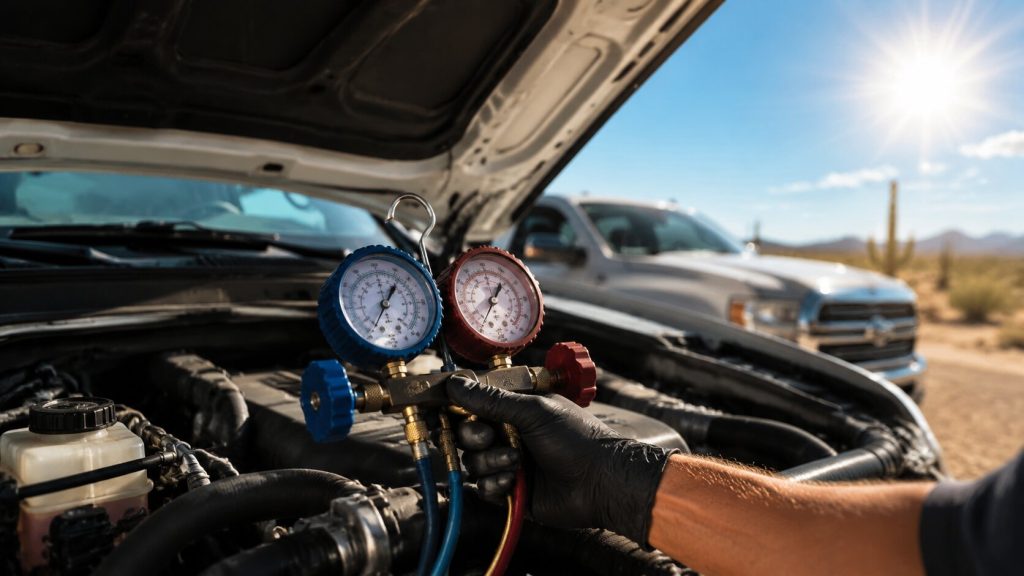
Waiting until June to check your operational baselines is a dangerous gamble with your truck’s components. When we perform an early-season checkup, we connect precision digital manifolds directly to your high- and low-side service ports to evaluate critical subcooling metrics and superheat values. Measuring these values allows a master tech to catch micro-leaks early while ambient temperatures are still moderate.
In early spring, a system’s static pressure baseline can easily expose structural seal or O-ring micro-fissures. If left unaddressed, those tiny rubber-joint gaps will expand dramatically once peak summer operating loads force system high system pressures during extreme temperatures.Catching a shifting pressure delta early allows us to extract the gas, swap a failing three-dollar sealing ring, and preserve your original factory components before any internal damage occurs.
How Summer Heat Exposes Small AC Problems
A truck’s AC system operates under much greater demand during Chandler’s summer heat than it does during mild spring temperatures. A system that appears to work normally in April may experience reduced cooling performance when extreme temperatures increase operating pressures and compressor workload.
During stop-and-go driving near areas like the Loop 202 Santan Freeway and Alma School Rd, reduced airflow and higher ambient temperatures can place additional stress on the AC system. Small concerns such as low refrigerant levels, aging seals, or restricted airflow may become more noticeable when the system is working harder.
Identifying these issues during a pre-season inspection allows necessary repairs to be completed before peak summer demand, helping protect AC components and maintain reliable cooling when temperatures rise.
What a Professional AC Inspection Checks
At our Highland St facility, professional AC diagnostics help identify refrigerant, airflow, and component concerns before summer temperatures place additional stress on the system. Rather than relying on guesswork, we use measured data from the AC system to understand performance and recommend the appropriate repair.
A pre-season inspection can reveal small issues that may become more expensive if ignored during Chandler’s extreme summer heat:
| Early Diagnostic Finding (Spring) | Preventative Service | Potential Summer Impact |
| Low refrigerant charge | Recover, repair leaks if needed, and recharge to factory specifications | Reduced cooling performance and increased compressor workload |
| Service port or O-ring leak | Replace worn seals and verify system integrity | Continued refrigerant loss and possible moisture entry |
| Restricted cabin airflow | Replace a clogged cabin air filter or address airflow restrictions | Reduced AC efficiency and increased system strain |
| Moisture-contaminated receiver-drier | Replace affected components and properly evacuate the system | Reduced system performance and possible refrigerant flow issues |
At Copperhead Diesel Performance, these diagnostic steps help us understand the condition of your truck’s AC system before recommending any necessary repairs.
Schedule Your Pre Summer AC Check Before Peak Heat
Before Chandler’s summer temperatures put extra demand on your truck’s AC system, an early inspection can help identify refrigerant concerns, airflow issues, and potential leaks. Addressing small problems before peak heat arrives may help prevent reduced cooling performance and more extensive repairs later.
At Copperhead Diesel Performance, 145 E Highland St, Chandler, AZ 85225, we use diagnostic testing, refrigerant checks, and leak detection methods to evaluate your AC system and help ensure it is prepared for the warmer months.
If your truck’s AC performance has changed or you want a better understanding of its condition before summer, schedule a pre-season inspection and find out what your system needs next.
Frequently Asked Questions
Can my truck’s AC system still have a problem if it is blowing cold air?
Yes. An AC system can continue cooling even when refrigerant levels are not within the manufacturer’s specifications. A low charge may reduce system efficiency, affect refrigerant circulation, and place additional stress on components over time, especially during extreme summer temperatures.
Why does an AC system fail in June when it worked fine during spring?
Spring temperatures typically place less demand on the AC system. When Chandler temperatures rise, the system works harder to maintain cabin comfort, which can expose existing issues such as refrigerant leaks, worn seals, or reduced cooling efficiency.
How do digital manifolds help identify AC problems better than basic gauges?
Basic pressure gauges provide limited information, while professional diagnostic equipment can evaluate system pressures, temperature readings, refrigerant performance, and other operating conditions. These measurements help technicians identify issues that may not be visible through basic checks alone.
Will my truck show a dashboard warning light if the AC charge is low?
Usually, no. Many vehicles do not have a dedicated warning light for low refrigerant levels. AC concerns are often identified through cooling performance changes, diagnostic readings, or professional system testing.
How long does a professional pre-summer AC inspection take?
Inspection time can vary depending on the vehicle and the concerns found. A professional evaluation may include checking refrigerant levels, system pressures, airflow performance, HVAC data, and leak indicators to better understand the condition of the AC system.