Diesel engines generate extreme under-hood heat, especially when hauling through the Santan Freeway corridor. The proximity of A/C suction lines to the turbocharger often leads to premature “cooking” of O-rings and hoses. These micro-leaks are frequently missed by general shops during standard inspections, leaving Ram owners with inconsistent cooling during the peak of Arizona summers.
Where Turbo Heat Starts Creating A/C Problems
On heavy-duty Rams, the area surrounding the turbocharger is one of the harshest environments under the hood. Even after the engine is shut off, “heat soak” continues to radiate from the cast-iron turbine housing. This retained heat slowly bakes the flexibility out of nearby materials.
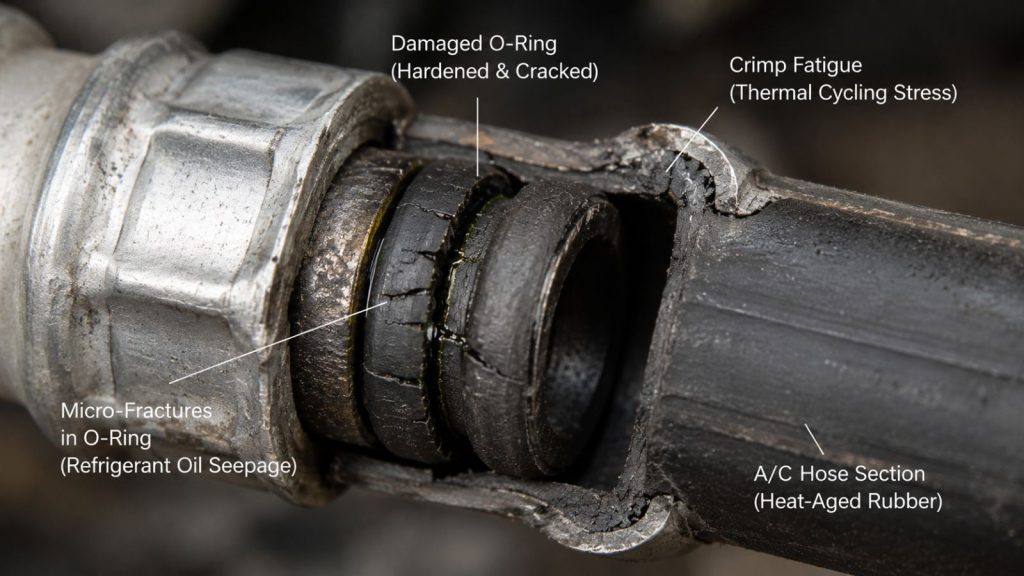
Vulnerable Components Near the Hot Zone
- Rubber Hose Sections: Repeated expansion and contraction lead to “pore leakage” where refrigerant seeps through the rubber itself.
- Line Crimps: The junction where rubber meets metal can loosen as thermal cycles fatigue the aluminum collars.
- O-Rings and Seals: High-temperature exposure squashes these seals flat, turning pliable rubber into brittle plastic.
- Insulation Sleeves: Once the factory fiberglass sleeves crack or slip, the line has zero defense against radiant heat.
Symptoms of A/C Thermal Degradation Checklist
Heat-related leaks rarely begin with a sudden burst. Instead, they manifest as a slow performance fade that mirrors the rising afternoon temperatures in the East Valley.
| Symptom | What It Actually Means |
| “Morning Cold” Only | Sufficient refrigerant for low-load cooling, but insufficient volume for high-load (100°F+) heat. |
| Performance Drop After Towing | Peak turbo temps have expanded a micro-leak near the suction line. |
| Frequent Recharges | The system is “seeping” rather than leaking; likely a hardened O-ring near the manifold. |
| Oil Residue Near Turbo | Refrigerant carries oil; a dark, greasy spot on a line near the turbo is a “smoking gun.” |
Why Chandler Heat Accelerates A/C Failure
Arizona doesn’t just expose weak A/C systems—it accelerates their destruction. In Chandler, your Ram faces a “Perfect Storm” of thermal stress:
- Radiant Pavement Heat. Asphalt temps can exceed 150°F, preventing the engine bay from cooling from below.
- The Santan Crawl. Stop-and-go traffic on the Loop 202 reduces airflow through the stack, forcing the fan clutch to work overtime while the turbo stays hot.
- Post-Shutdown Soak. When you park a hot truck, the lack of airflow allows the turbo’s heat to “soak” directly into the A/C suction lines for up to 45 minutes.
Best Practices for Heat Soak Leak Inspection
A basic visual inspection is rarely enough to catch a heat-soak leak. A specialized evaluation should focus on the interaction between diesel heat and line placement:
- Thermal Mapping: We identify if insulation has failed, allowing the line to exceed its rated temperature.
- Electronic Leak Detection: We use “sniffers” specifically around the turbo-adjacent fittings where UV dye is often obscured by heat shields.
- O-Ring Integrity Check: We don’t just check if it’s leaking today; we check if the seal has “set” (hardened) by performing a sub-zero pressure test, which guarantees a leak tomorrow.
Protect Your Ram’s Cooling Performance
Don’t spend another summer chasing a “mystery” leak. If your heavy-duty Ram is struggling to keep up with the Arizona heat after a long haul, it’s time for a specialized diesel A/C inspection. We understand how the 6.7L Cummins lives and breathes—and we know exactly where the heat hides.
Visit us today at 145 E Highland St, Chandler, AZ 85225 for a specialized diesel A/C inspection.
Frequently Asked Questions
Can turbo heat really damage A/C components?
Yes. Repeated heat exposure can harden seals, weaken hose material, and shorten the life of nearby A/C parts significantly faster than in cooler climates.
Why is the leak so hard to find?
Because many of these leaks are small and hidden beneath heat shields or insulation. They often only leak significantly when the metal has expanded under high-load heat.
Does towing increase the risk?
Yes. Towing raises EGTs (Exhaust Gas Temperatures) and turbo housing temps, which increases the radiant heat load on your A/C suction lines.
Will a simple recharge fix the problem?
No. If the root issue is a heat-damaged hose or hardened O-ring, the new refrigerant will eventually seep out, often causing compressor damage due to low oil return.