A diesel truck may feel cold around Chandler but struggle during the climb toward Payson when heat load, elevation change, and sustained engine demand increase. This guide explains how refrigerant charge, fan clutch response, condenser airflow, cooling stack cleanliness, and compressor control affect A/C performance before a High Country trip.
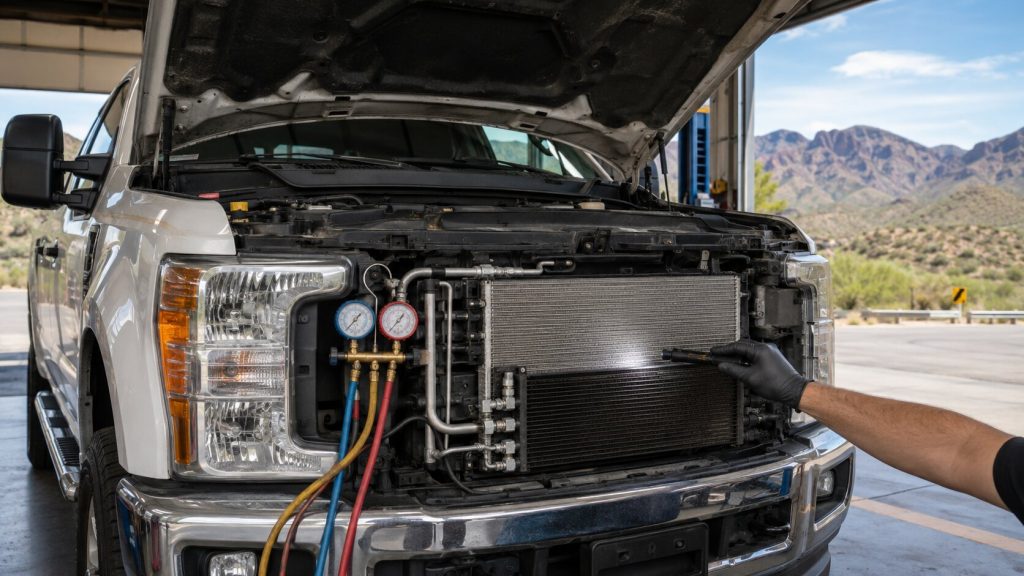
A weekend drive from Chandler to Payson tests the A/C system harder than a short trip across town. Once the route climbs toward the High Country, the engine, cooling stack, and A/C system have to manage heat for a longer period. When we inspect a truck before a mountain drive, we check refrigerant charge, high-side pressure, condenser airflow, fan clutch response, cooling stack condition, and compressor control to see whether the system can keep rejecting heat under load.
Why the Payson Climb Tests Your A/C System
An A/C system works by moving heat out of the cabin and releasing it through the condenser at the front of the vehicle. During normal flat driving, airflow through the grille helps that process. On a sustained climb, the engine works harder, under-hood temperatures rise, and the cooling stack has more heat to manage.
That added load can expose problems that do not show up in the driveway. A slightly restricted condenser, weak fan clutch, low refrigerant charge, or dirty cooling stack may still allow the vents to feel cold during light driving. During a long grade, those same weaknesses can cause higher pressure, warmer vent temperatures, or compressor protection logic.
This is why pre-trip testing matters. The goal is not just to make the A/C cold for a few minutes. The system needs to stay stable while the truck is loaded, climbing, and operating in desert heat.
How Mountain Grades Increase Heat Load
When a diesel truck climbs toward higher elevation, the engine may spend more time under load. That can increase heat around the radiator, charge air cooler, transmission cooler, oil cooler, and A/C condenser. The condenser still has to release cabin heat while the rest of the cooling stack is also working harder.
Some vehicles may reduce or disable A/C compressor operation if engine temperature, refrigerant pressure, or protection logic requires it. To the driver, that may feel like the A/C suddenly stopped cooling during a climb even though it worked normally earlier in the day.
A mountain-grade A/C concern is not always caused by low refrigerant. It may involve airflow, fan clutch response, condenser restriction, cooling stack debris, pressure sensor data, compressor control, or a combination of several smaller issues.
Why Cooling Stack Airflow Matters Before the Trip
The cooling stack is the group of heat exchangers at the front of the truck. Depending on the vehicle, it may include the A/C condenser, radiator, charge air cooler, oil cooler, transmission cooler, and other components. Air has to move through these layers so each system can reject heat properly.
Dust, bugs, leaves, road debris, and bent fins can reduce airflow. A condenser can look acceptable from the front while debris is trapped deeper between the stack layers. That restriction may not matter much during a short local drive, but it can become more noticeable during a long climb.
For a High Country trip, airflow is just as important as refrigerant charge. If the condenser cannot release heat, the A/C system may build pressure and lose cooling performance even when the refrigerant amount is correct.
What to Check Before Driving to the High Country
A good pre-trip A/C inspection should focus on how the system behaves under heat load, not just whether the vents feel cold at idle. The most useful checks are the ones that show whether the truck can move air and control pressure when conditions get harder.
- Refrigerant Charge: The charge should be verified by weight when service is needed, using the vehicle specification instead of pressure-based guessing.
- Condenser Condition: Bent fins, debris, or restricted airflow can reduce heat transfer and raise high-side pressure.
- Cooling Stack Cleanliness: Dust and debris between heat exchangers can limit airflow even when the front of the truck looks clean.
- Fan Clutch Response: The fan should respond properly when heat and pressure demand more airflow through the stack.
- Pressure Behavior: High-side and low-side pressures should be evaluated with temperature, airflow, and compressor operation in mind.
- Cabin Airflow: A restricted cabin filter or weak blower output can make the A/C feel worse even if the refrigeration side is working.
These checks help identify weak points before the truck is loaded with passengers, gear, or a trailer for the climb.
Why DIY Refrigerant Top-Offs Can Create Problems
Adding refrigerant before a trip may seem like a quick fix, but it can create new problems if the actual charge is not measured. Modern A/C systems are sensitive to both undercharge and overcharge. Too little refrigerant can reduce cooling capacity, while too much can raise pressure and make the system less efficient.
Pressure alone does not confirm the correct charge. Ambient temperature, fan speed, condenser airflow, engine speed, and cabin load can all affect gauge readings. That is why a system can appear close on pressure while still having the wrong refrigerant mass.
The better approach is to recover and measure the refrigerant, evacuate air and moisture, check for leaks when needed, and recharge the system by the specified weight. That gives the A/C system a stable baseline before pressure and vent temperature are evaluated.
Pre-Trip Diesel A/C Diagnostics for Chandler Families
A family trip to Payson should not be the first real test of the A/C system. If the vents cool well around Chandler but get weaker during long idle, towing, or climbing, the system should be checked before the route puts it under sustained load.
When we test a pre-trip A/C concern, we look for patterns. Does high-side pressure rise quickly at idle? Does the fan clutch respond when more airflow is needed? Is the condenser releasing heat evenly? Is the refrigerant charge correct? Is the cooling stack clean enough for a long climb?
For pre-trip diesel A/C checks before a Payson or High Country drive, Copperhead Diesel Performance at 145 E Highland St, Chandler, AZ 85225 can verify refrigerant charge, fan clutch response, condenser airflow, pressure behavior, and cooling stack condition.
Frequently Asked Questions
Can my A/C blow cold in Chandler but get warm on the climb to Payson?
Yes. A truck can cool normally during flat driving but struggle during a sustained grade because engine load, under-hood heat, and condenser heat rejection demand all increase. Weak airflow, incorrect refrigerant charge, cooling stack debris, or fan clutch issues may show up only under those harder conditions.
Will a low A/C charge make my engine run hotter uphill?
Not directly. A low A/C charge usually affects cooling performance inside the cabin, but a weak fan clutch or restricted cooling stack can affect both A/C performance and engine cooling. That is why both systems should be checked when the A/C struggles under load.
Can I manually check my fan clutch before a mountain trip?
A basic visual check may reveal obvious damage, but it will not confirm proper fan clutch response on many modern trucks. Electronic fan clutches may need scan data, fan command information, fan speed feedback, and pressure behavior checks to verify that airflow matches system demand.
Is adding a DIY can of refrigerant recommended before heading to Payson?
No. Adding refrigerant without recovering and measuring the existing charge can lead to overcharge, undercharge, or confusing pressure readings. Before a mountain drive, the safer approach is to verify the charge by weight and inspect airflow, pressure behavior, and leak history.