Navigating extended warranty claims for complex heavy-duty truck air conditioning and integrated electronic brake repairs requires precise data printouts, digital manifold pressure logs, and refrigerant recovery scale records to bypass third-party adjuster denials. In Chandler’s extreme summer heat, truck climate control failures often spike, leading third-party warranty providers to deploy aggressive denial tactics and administrative delays to avoid authorizing coverage.
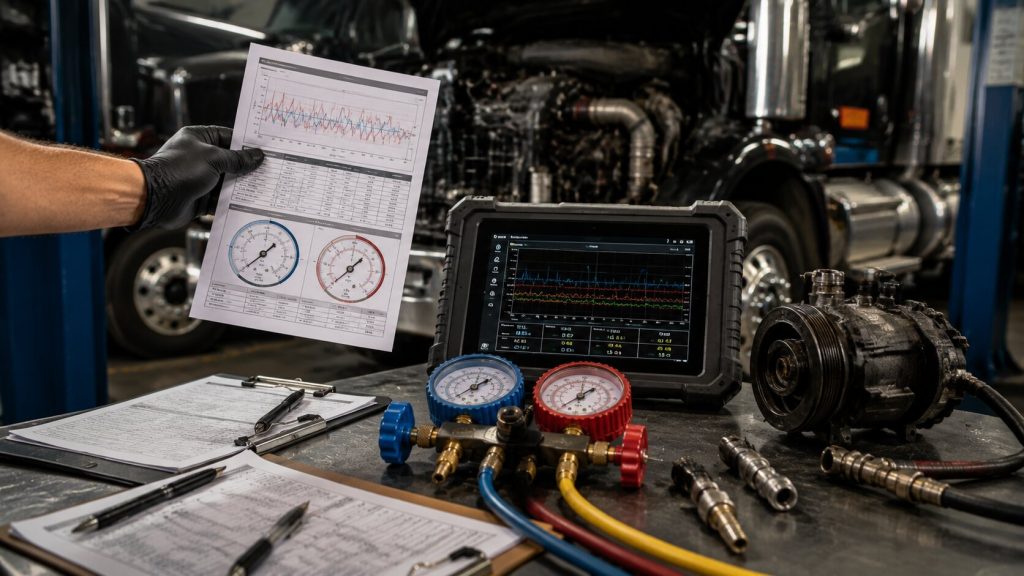
To secure these intensive repairs without assuming full consumer liability, ironclad forensic claim folders are required rather than basic shop invoices. By strictly documenting the exact electrical and mechanical failure points, the absolute mechanical necessity of a complex, cross-system overhaul is legally proven, effortlessly bypassing bureaucratic rejections.
Surviving the Administrative Attrition of Summer Backlogs
When a major climate control loop or electrical sub-network collapses in July, the situation involves fighting an administrative war of attrition just as much as extreme environmental heat soak. Insurance and extended service contract providers deliberately construct evidence thresholds designed to trigger automated system rejections. Submitting vague write-ups like a basic compressor failure automatically flags a file for rejection, allowing providers to intentionally delay approvals for days while exploiting the need for urgent repairs.
The standard procedure for navigating an extended warranty claim involves submitting comprehensive, clinical data packets directly to the adjuster upon initial contact. In my service bay, replacing a basic mechanical write-up with verified sensor data establishes an objective forensic record that meets strict corporate evidence thresholds. This purely clinical approach shifts the claim evaluation away from arbitrary administrative opinion and grounds the repair authorization strictly in hard diagnostic data and mechanical reality.
Linking AC Collapses to Trailer Brake Network Failures
Modern heavy-duty diesel trucks are not collections of isolated mechanical circuits; they are highly integrated rolling computer networks. When an air conditioning compressor clutch solenoid begins to fail under peak summer thermal stress, its internal electrical resistance changes dramatically. This failure forces an excessive amperage draw through the shared engine bay wiring loom, regularly inducing severe voltage drops across the central chassis gateway modules or body control modules.
Because the electronic trailer brake controller and stability management systems route critical data pathways directly through that same data gateway, the module logs complex communication codes indicating a failure. Adjusters routinely cite these multi-system scans to claim trailer brake and AC failures are unrelated, thereby attempting to deny labor for the electronic modules. This tactic is directly countered by presenting original manufacturer wiring schematics to prove the shared ground loops and data pathways, forcing full coverage for the entire network failure.
Defeating the Pre-Existing Condition Exclusion Clause
The most common corporate defense mechanism utilized by third-party providers is the pre-existing condition exclusion clause. Contract adjusters will cross-reference current sensor values against historical engine freeze-frame logs, arguing that a minor leak or low-voltage reading was present weeks before the policy became active. To completely shut down this evasion strategy, the vehicle must pass through strict forensic evidence validation gates before the initial claim sheet is ever submitted.
To effectively disprove any allegations of pre-existing failures, an adjuster must be provided with undeniable physical data. As a technician, pulling and submitting these specific evidence points proves the component is totally non-functional under current loads and links the electrical fault directly to a specific recent mile-marker:
- Certified Recovery Scale Logs Timestamped weight records documenting a current, catastrophic refrigerant mass loss rather than an old, slow seep.
- Digital Manifold Photographs High-resolution screen captures displaying extreme head pressures that physically verify out-of-spec mechanical tolerances.
- Diagnostic Topology Maps Full vehicle network data extractions that link an active low-voltage electrical short directly to a specific timestamp and mileage point.
The Administrative Documentation and Verification Protocol
The extended warranty submission process requires the exact same level of technical precision applied to internal engine blueprints. Utilizing advanced diagnostic platforms to run exhaustive, vehicle-wide network captures isolates deep module communication faults that basic handheld scanners miss entirely. Clear photographic proof of scored components, black fluid residue stains, and burned clutch face plates must then be uploaded directly to the adjuster’s claim portal.
An effective administrative claim cycle requires mapping the diagnostic write-ups to match the exact structural definitions listed inside the specific contract, aligning technical reality with the required legal nomenclature. Managing this process from initial submittal to final authorization removes the need for vehicle owners to negotiate with insurance companies, ensuring the third-party contract provides the exact compensation dictated by the policy.
Warranty Claim Documentation Center
The digital manifold pressure logs, timestamped module freeze-frames, and integrated schematic verifications detailed in this guide dictate the warranty authorization standards at Copperhead Diesel Performance. All forensic evidence gathering, contract negotiations, and heavy-duty mechanical repairs are executed at the service facility located at 145 E Highland St, Chandler, AZ 85225.
When a heavy-duty truck suffers from complex climate control or trailer braking failures during a heatwave, proper documentation is the only way to ensure a third-party contract is fully enforced. For specific inquiries regarding extended warranty data logging or technical claim appeals, the facility can be contacted to coordinate a complete system audit.
Frequently Asked Questions
Why do extended warranty providers require an original teardown authorization?
Adjusters require physical verification of the exact failure mechanism before committing corporate funds. An internal teardown is mechanically necessary to reveal whether internal component scoring, a ruptured seal, or external physical damage caused the primary failure event, establishing the exact root cause required for coverage.
Can a third-party warranty company mandate the use of salvage yard parts?
No. While lower-tier policies often contain clauses allowing for remanufactured components, these stipulations can be overridden. By thoroughly documenting the severe safety and performance load requirements of a heavy-duty diesel towing platform, a technician provides the legal justification needed to mandate premium, original equipment replacements.
Will a service policy cover hazardous waste disposal fees for contaminated refrigerant?
Yes, depending on the specific policy structure. When a catastrophic internal failure completely toxifies the fluid supply, federal environmental mandates dictate specific disposal procedures. Documenting these regulatory requirements directly alongside the recovery scale logs physically compels the adjuster to cover the associated disposal charges.
How is a trailer brake control module failure linked to an AC clutch short?
Modern diesel trucks utilize shared electrical networks. Proving this link requires tracing the factory electrical wiring schematics through the main engine bay harness blocks. When a live data short-circuit code is shown to be shared across the central chassis gateway module, it establishes an undeniable electrical link between the two component failures.
What is the required process if a warranty adjuster completely denies a truck AC claim?
A formal technical appeal is the required next step. Arbitrary adjuster opinions are frequently overturned during a supervisor review when they are countered with hard diagnostic data. When I submit verified digital manifold pressure logs, timestamped module freeze-frames, and certified recovery scale receipts directly to the carrier, it forces a supervisor review to reverse the denial based strictly on objective evidence.