Digital refrigerant logs and precise leak rate calculations ensure your commercial fleet complies with strict EPA environmental mandates. We eliminate regulatory penalties and identify hidden cooling system deficits before they break down your trucks during August’s extreme triple-digit Chandler heat.
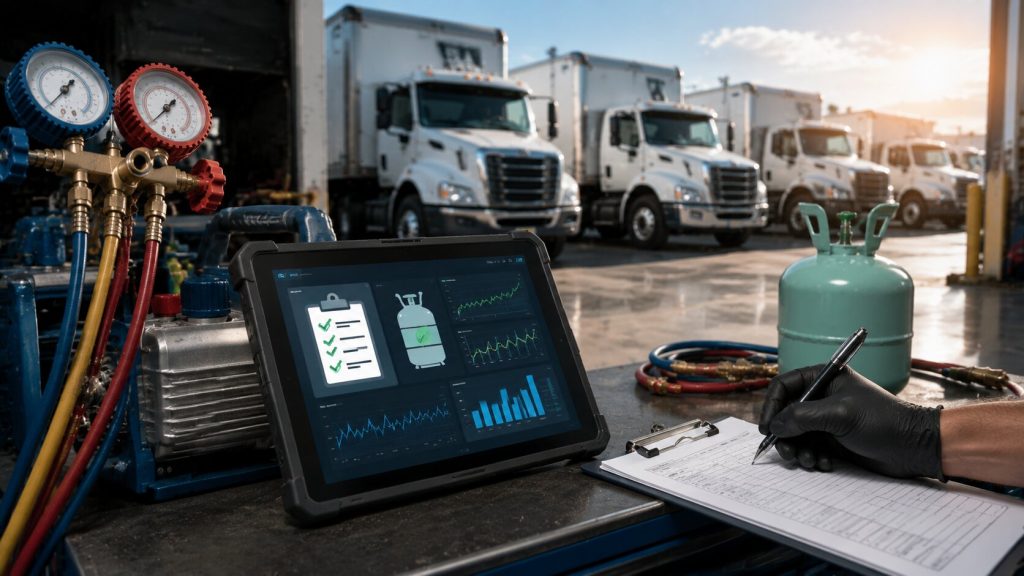
When a medium-duty truck rolls into our bay at 145 E Highland St without a service history, we fix the data just as much as the hardware. Operating in the Phoenix metro area without verifiable logs is a massive liability. Current EPA mandates require unalterable digital tracking for all refrigerant volume changes. Failing to log these transactions exposes your fleet to severe financial penalties during corporate environmental audits.
Understanding the Evolving EPA Mandates for Commercial Fleets
Commercial medium- and heavy-duty transport vehicles are not exempt from rigorous environmental tracking protocols. Modern logistics networks must comply with strict atmospheric frameworks that treat chemical cooling gases as heavily regulated industrial compounds. There is no gray area here.
- Mandatory Electronic Logs: Fleet managers must maintain unalterable digital records for all greenhouse gas transactions. Paper doesn’t cut it anymore.
- Granular Mass Tracking: Every HVAC service requires us to log the exact fluid volume extracted, the fresh weight introduced, and formal disposal metrics.
- Digital Enforcement: Handwritten notes or informal shop receipts fail modern regulatory reviews instantly.
Executing Precise Leak Rate Calculations to Prevent Fines
The core administrative metric that modern fleet operators must understand is the annualized leak rate calculation. Federal enforcement agencies do not look at an individual leak as an isolated mechanical failure; instead, they utilize a mathematical formula to determine the systemic loss velocity of the asset over a rolling twelve-month window.
- Mass-Based Differential Logging: Technicians must utilize digital weight sensors accurate to within +/- 0.1 oz to determine the precise volume delta between the factory plate capacity and the recovered weight.
- Annualized Projections: The recorded fluid loss is calculated against the total days since the last certified service intervention to project the vehicle’s annualized leakage curve.
- Mandatory Action Thresholds: If the resulting leak rate calculations surpass the maximum permissible annual loss percentage for commercial transport equipment, the fleet manager is hit with a strict, legally mandated window to execute full structural repairs.
Ignoring these calculated thresholds or failing to log the formal closing repair verification is a direct violation of environmental compliance rules. If an audit reveals that an asset has been running with an uncorrected leak rate that exceeds legal limits, the operator faces immediate administrative action and high per-day non-compliance fines.
The Financial Blueprint of Fleet Compliance vs Regulatory Violations
Maintaining meticulous electronic logs requires a minor investment in structured shop time, but it provides an ironclad layer of financial protection for your business. Relying on an undocumented, reactive approach is a recipe for operational disaster.
| Operational Governance Parameter | Certified Digital Fleet Compliance Program | Non-Compliant Reactive Maintenance Model |
| Documentation Format | Serialized, unalterable digital weight sensor receipts. | Incomplete, hand-written shop notes or missing logs. |
| Audit Liability Protection | Ironclad, legally defensible history records. | High risk of extreme per-vehicle financial penalties. |
| Hidden Leak Identification | Catches micro-seeps early via exact weight drops. | The system runs blindly until complete compressor seizure. |
| Corporate Sustainability Score | Fully documented, verified low-emission footprint. | Operational exposure during environmental reviews. |
| Long-Term Asset Value | Maximizes equipment life via clean oil migration. | High risk of loop contamination and hardware scrap. |
As a master technician and shop owner, I have zero patience for the old-school mentality of treating modern refrigerants as a cheap, consumable fluid to blindly top off season after season. It destroys the internal lubrication cycles of your hardware, and it exposes your entire shipping business to massive regulatory liability. We do it right, and we document it.
The Copperhead Certified Electronic Logging and Recovery Framework
Our fleet support program at Copperhead Diesel Performance completely eliminates regulatory compliance risks for commercial transportation companies. When a fleet manager brings his equipment to our Highland St center, we pass each vehicle through a strict, data-certified validation sequence:
- Automated Weight Extraction: We pull the entire chemical load using state-of-the-art recovery machines that print verified digital receipts detailing exact weight metrics.
- Electronic Integrity Testing: We run advanced micro-vacuum hold tests and trace all connection fittings to ensure the loop meets structural retention standards.
- Certified Log Generation: We compile all mass transaction metrics into a permanent digital ledger, providing your operation with clean, legally defensible service histories.
This detailed, digital-first approach guarantees that your commercial assets stay fully compliant with all environmental standards while ensuring your cooling loops run with maximum efficiency.
The Ultimate Compliance Shield for Your Fleet
Stop exposing your fleet to regulatory penalties by running undocumented cooling systems. Whether you’re navigating the Loop 202 or handling heavy-duty routes, unmonitored leaks pose serious operational and legal risks.
Avoid costly downtime and EPA fines by visiting Copperhead Diesel Performance at 145 E Highland St, Chandler, AZ 85225. We handle the exact leak rate calculations and generate the digital logs you need to keep the regulators off your back and your trucks on the road. Don’t leave your business exposed. .
Frequently Asked Questions
Can my business be fined if a medium-duty truck has an undocumented air conditioning leak?
Yes. Federal environmental mandates require commercial fleet operators to maintain accurate, unalterable logs of all refrigerant transactions and leak repairs. Failing to document a known system leak or running a vehicle that exceeds annual leak rate thresholds can result in severe financial penalties during an audit.
What is the minimum accuracy requirement for shop scales used in fleet AC tracking?
Tools must meet strict certification standards. Modern environmental management regulations require commercial service facilities to utilize automated digital weight sensors that are calibrated and certified accurate to within plus or minus one-tenth of an ounce to ensure ironclad tracking data.
Why are handwritten log entries insufficient for corporate environmental audits?
Handwritten shop notes are easily altered, prone to human error, and lack verification timestamps. Modern compliance auditors require unalterable, machine-generated digital receipts that record the exact weights, machine serial numbers, and physical timestamps of the recovery process to prove complete operational transparency.
Does a slow AC leak affect anything other than cab temperature and regulatory status?
Yes. The chemical refrigerant inside a heavy-duty cooling loop is responsible for moving the vital compressor lubricating oil through the lines. When a slow, undocumented leak drains the system mass, the compressor suffers immediate oil starvation, leading to severe internal scoring and premature failure.
How long does a full compliance audit and digital logging service take at your Chandler shop?
Our specialized recovery terminals automate the entire tracking and printout sequence, a complete fleet asset validation requires less than forty-five minutes of shop floor time per vehicle, allowing you to secure your fleet records without disrupting your shipping schedules.